

The prospect of commercial supersonic travel has hovered at the edge of feasibility for decades. Since the retirement of Concorde, the prevailing assumption within aviation was that speed beyond Mach 1 had become incompatible with modern regulatory, environmental, and economic realities. The limitation was never propulsion alone. It was noise.
The sonic boom, produced when shockwaves merge as an aircraft exceeds the speed of sound, rendered overland supersonic flight politically and legally untenable. What changed this equation was not a single breakthrough, but a convergence of aerodynamic design, materials science, and computational modeling.
By early 2026, flight data from the NASA X-59 program has demonstrated that sonic shockwaves can be reshaped rather than eliminated. The result is not silence, but transformation. Instead of the sharp double boom that once rattled buildings, the pressure signature is stretched and dispersed into what engineers describe as a “sonic thump,” comparable to distant thunder.
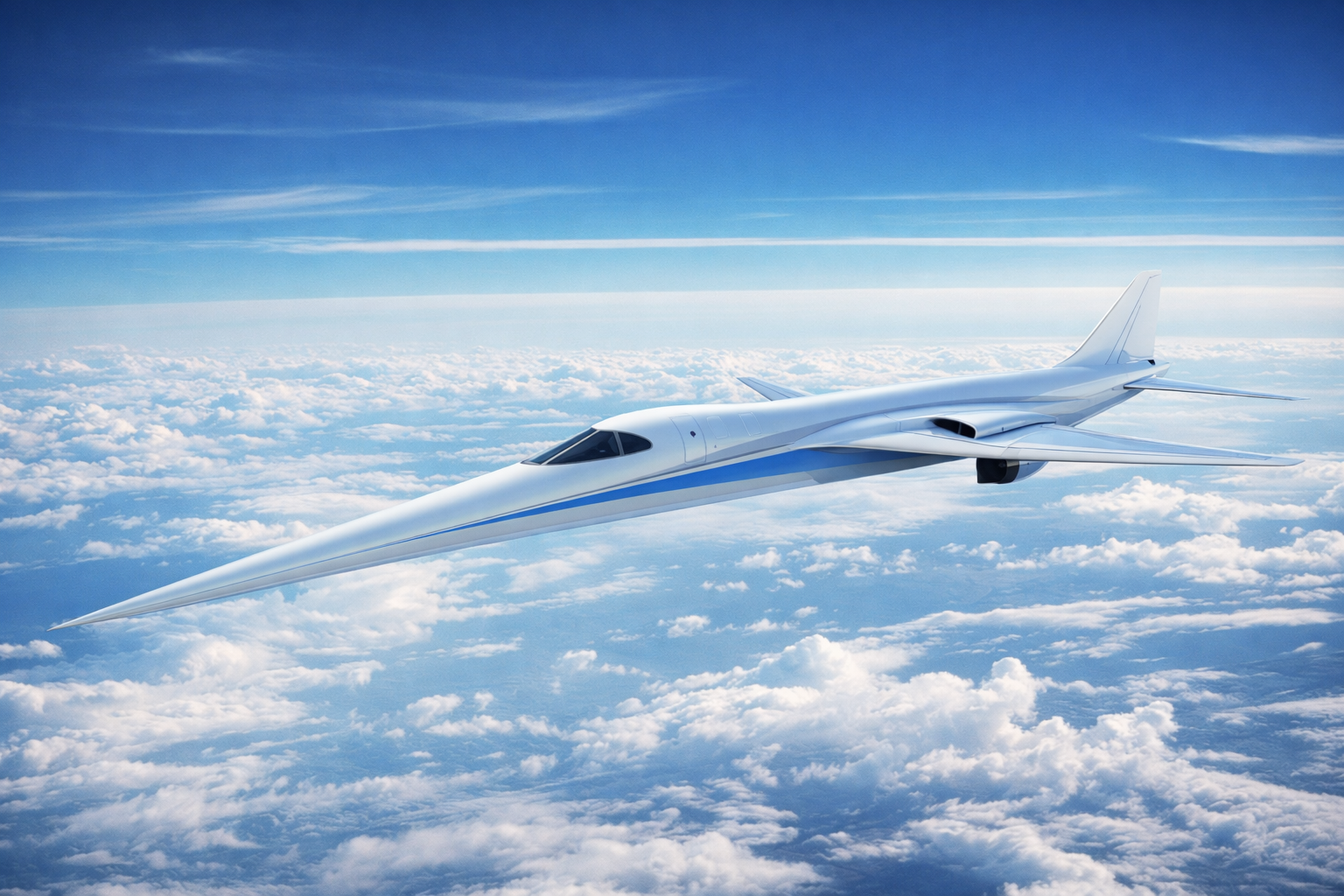
This shift represents a structural change in supersonic feasibility rather than an incremental improvement. The key lies in aerodynamic shaping. Elongated fuselages, needle-like noses, and carefully positioned engine inlets prevent shockwaves from converging at a single point. Computational fluid dynamics models now allow engineers to sculpt airflow with a precision that was unavailable during the original supersonic era.
The implications extend beyond acoustics. Once overland supersonic flight becomes permissible, route economics change fundamentally. Transcontinental journeys that currently require five to six hours could be reduced to under three. For certain global business corridors, same-day intercontinental travel becomes operationally realistic rather than aspirational.
This prospect has reawakened investor interest across the aerospace sector. Capital is flowing not toward speculative speed records, but toward airframe durability, thermal resilience, and operational efficiency. Sustained supersonic flight exposes aircraft to extreme aerodynamic heating, particularly along leading edges and engine nacelles. Modern designs rely on advanced carbon fiber composites and ceramic-matrix materials that can tolerate repeated thermal cycling without degradation.
Unlike Concorde, next generation supersonic aircraft are not being developed as technological showpieces. They are being designed as commercial platforms constrained by fuel economics, maintenance cycles, and regulatory certification. This shift in philosophy is critical to their viability.
Fuel remains a central variable. Supersonic travel is inherently energy intensive, and its revival would have been politically untenable without parallel progress in sustainable aviation fuels. New designs are optimized to operate on high blends of SAF, reducing lifecycle emissions while maintaining performance. In this context, aerodynamic efficiency and environmental impact are treated as interdependent engineering problems rather than competing priorities.
The cockpit architecture has also evolved. Traditional forward windows impose aerodynamic penalties at supersonic speeds. Modern designs increasingly rely on synthetic vision systems that combine high-resolution cameras with augmented displays. This allows for streamlined nose profiles while preserving situational awareness, particularly during takeoff and landing phases.
From a regulatory standpoint, quiet boom technology alters the risk calculus for aviation authorities. Noise impact has historically been the decisive barrier to overland supersonic approval. If pressure signatures can be reliably kept below established thresholds, the conversation shifts from prohibition to certification. That transition is already underway, though full regulatory frameworks remain in development.
Market segmentation is likely to follow a familiar pattern. Early adoption will concentrate in premium and business aviation, where time savings justify higher operating costs. Over time, economies of scale and airframe refinement may allow broader deployment, particularly on high-density routes where speed offers clear productivity gains.
The broader significance of this transition lies in what it represents for aerospace innovation. For much of the past twenty years, aviation optimization focused almost exclusively on efficiency and emissions reduction. Quiet boom technology reintroduces speed as a legitimate design objective, without abandoning environmental constraints.
Supersonic travel’s return is therefore not a nostalgic revival, but a reframing of what modern aviation can balance. Speed, sustainability, and regulatory compliance are no longer mutually exclusive. They are becoming integrated design parameters.
As the decade progresses, the success of this technology will not be measured by headline-grabbing velocities, but by operational reliability and regulatory acceptance. If aircraft can routinely cross continents at Mach speeds without disturbing those on the ground, the geography of time itself changes.
In that outcome, the true breakthrough is not flight faster than sound, but flight that respects the space beneath it.