

Close Menu
Briefory
    What's Hot

    The Sovereignty of the Self in an Age of Algorithmic Governance

    13.02.2026

    The Chronos Strategy and the Death of the Always-On Executive Culture

    13.02.2026

    Direct Indexing and the Democratization of Tax-Loss Harvesting for High-Net-Worth Portfolios

    13.02.2026
    Facebook X (Twitter) Instagram
    Trending
    • The Sovereignty of the Self in an Age of Algorithmic Governance
    • The Chronos Strategy and the Death of the Always-On Executive Culture
    • Direct Indexing and the Democratization of Tax-Loss Harvesting for High-Net-Worth Portfolios
    • The Fragmentation Gamble and the Rise of Issue-Based Partnerships in the Global South
    • The Polycentric Shift and Why American Transactionalism is Redefining Global Power Dynamics in 2026
    • The Neuro-Symbolic Pivot and Why Pure Neural Networks are Reaching a Reasoning Ceiling
    • Trans-Arctic Cable Initiative Gains Momentum Amid Strategic Rivalry
    • Beyond Silicon and the Commercial Viability of Diamond-Based Power Electronics
    Facebook X (Twitter) Instagram
    BrieforyBriefory
    Sunday, April 19
    • World
      • Americas
      • Europe
      • Asia-Pacific
      • Africa
      • Middle East
    • Economy & Business
      • Global Economy
      • Real Estate
      • Startups
    • Finance & Markets
      • Stock Market
      • Crypto & Web3
      • Commodities
      • Forex
    • Health & Biohacking
      • Longevity
      • Mental Wellness
      • Medical Breakthroughs
    • Lifestyle & Luxury
      • High-End Travel
      • Sustainable Living
      • Work-Life Balance
    • Personal Finance
      • Global Tax & Equity
      • Retirement Planning
      • Wealth Management
    • Perspectives
      • Expert Briefings
      • Future Trends
      • Global Opinions
    • Tech & AI
      • Artificial Intelligence
      • Cyber Security
      • Future Tech
    • The Brief
      • Daily Briefings
      • Tech Radar
      • Deep Dives
    Briefory
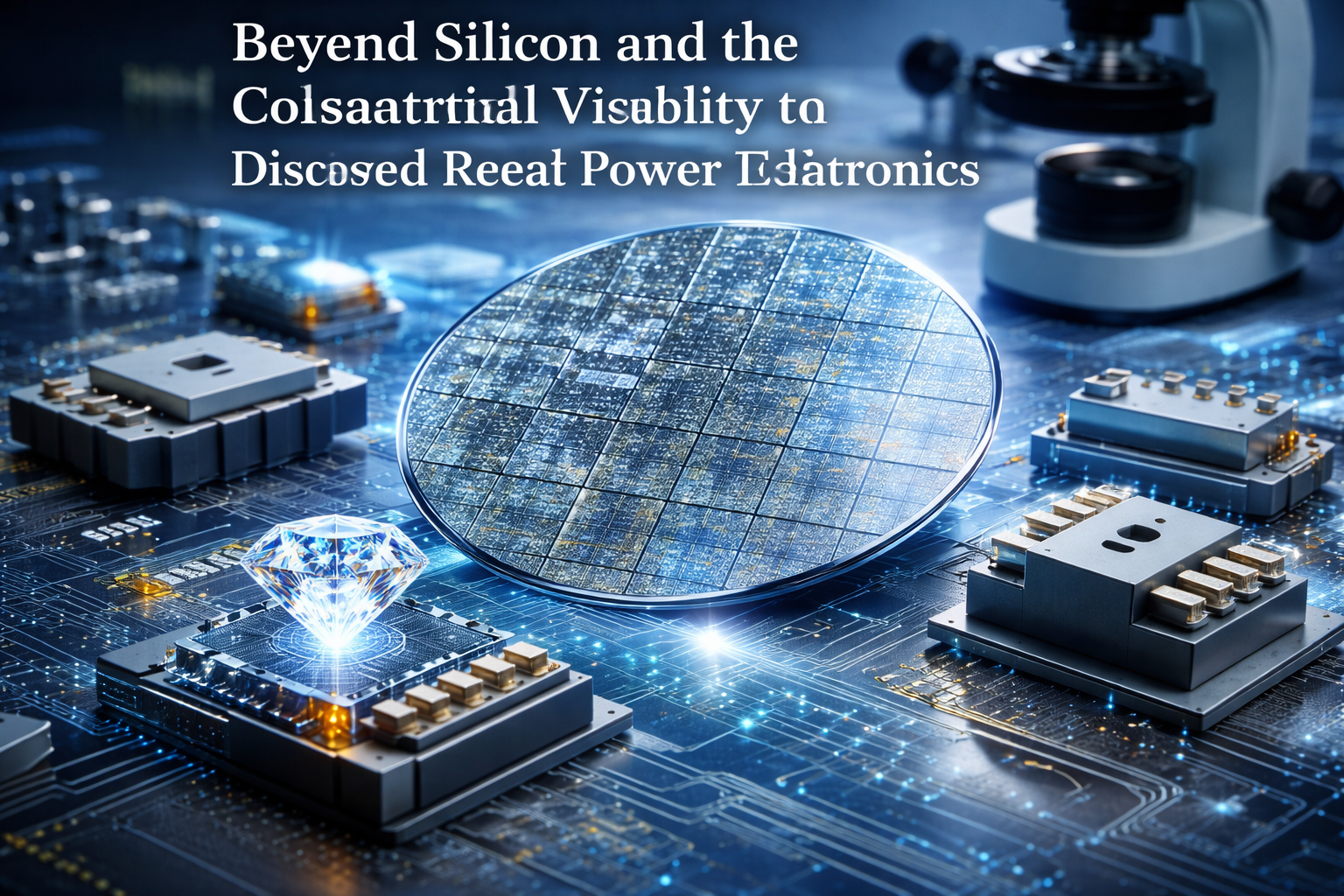
    Editorial photograph of a diamond semiconductor wafer and power modules on a circuit board in a laboratory setting, illustrating research into diamond based power electronics.

    Beyond Silicon and the Commercial Viability of Diamond-Based Power Electronics

    0
    By Briefory Intelligence on 13.02.2026 Tech Radar, The Brief
    Share
    Facebook Twitter LinkedIn Copy Link

    For more than half a century, silicon has defined modern electronics. Its abundance, manufacturability, and well understood physical properties made it the foundation of computing, communications, and power systems. Even as new materials such as gallium nitride and silicon carbide entered the market, silicon remained dominant in cost sensitive and high volume applications.

    But power electronics is undergoing a gradual shift. The demands of electrification, data center expansion, electric vehicles, and grid modernization are stretching the limits of traditional semiconductor materials. Higher voltages, greater thermal loads, and tighter efficiency standards are forcing engineers to reconsider material constraints. In that context, diamond based power electronics has moved from laboratory curiosity to early stage commercial discussion.

    Diamond offers properties that are difficult to ignore. It has an exceptionally wide bandgap, high thermal conductivity, and strong breakdown electric field. In simple terms, devices built from diamond could operate at higher voltages, handle more heat, and reduce energy losses compared with silicon. In power conversion systems, even small efficiency gains translate into meaningful cost savings over time. Heat management alone accounts for a significant share of system design complexity.

    The technical promise is clear. The commercial path is less certain.

    Unlike silicon, which benefits from decades of industrial scale fabrication infrastructure, synthetic diamond production remains specialized and expensive. Chemical vapor deposition techniques can produce high quality diamond substrates, but scaling them consistently and economically remains challenging. Defect density, doping control, and wafer size are still areas of active development. These are not marginal issues. They determine yield, cost per device, and long term reliability.

    Investors and corporate R and D departments are therefore approaching diamond electronics with measured interest. Several startups and research consortia are exploring niche applications where performance advantages justify higher upfront costs. Aerospace systems, high frequency radar, and extreme environment energy systems are often cited. In such cases, the value of thermal resilience and voltage tolerance may outweigh material expense.

    The broader commercial question revolves around cost curves. Silicon carbide and gallium nitride faced similar skepticism two decades ago. Over time, manufacturing scale, improved crystal growth techniques, and learning effects reduced costs and expanded adoption. Diamond may follow a comparable trajectory. Or it may remain confined to specialized markets if production challenges persist.

    Another factor is system integration. Power electronics does not operate in isolation. Devices must interface with packaging technologies, cooling systems, and control architectures. Introducing a new material requires adjustments across the supply chain. Foundries must adapt tooling. Designers must validate long term stability. Standards bodies may need to update testing protocols. Each step introduces friction.

    Energy transition policies add complexity. Governments are incentivizing grid efficiency, renewable integration, and electrified transport. If diamond based devices demonstrably reduce energy loss at scale, they could align with policy objectives. Public funding for advanced materials research may accelerate development. Yet policymakers are typically cautious about subsidizing technologies that lack clear cost competitiveness.

    There is also the competitive landscape to consider. Silicon is not static. Continuous improvements in fabrication nodes and device architecture extend its relevance. Silicon carbide and gallium nitride are already scaling in electric vehicles and fast charging infrastructure. Diamond must compete not only with silicon but with these intermediate materials that are further along the commercialization curve.

    From a market perspective, viability depends on a narrow but important calculation. If diamond devices enable smaller systems, lower cooling requirements, and longer operational lifetimes, total system cost could fall even if component cost remains high. Such trade offs are familiar in industrial procurement. Capital expenditure is weighed against operational savings over years, sometimes decades.

    In conversations with engineers involved in grid infrastructure upgrades, the emphasis is often less on novelty and more on reliability. Materials that perform under stress without degradation command attention. But reliability must be demonstrated through field data, not laboratory benchmarks. That transition from controlled testing to real world deployment is where many advanced materials stall.

    The semiconductor industry has historically moved in cycles of consolidation and specialization. Some materials achieve mass adoption. Others define high margin niches. Diamond based power electronics may follow either path. Its physical advantages are difficult to dispute. Its economic case remains under construction.

    What is clear is that pressure on power systems will intensify. Data centers demand more energy. Electrified transport expands load profiles. Renewable generation introduces variability. Materials science will play a central role in meeting these demands. Whether diamond becomes foundational or remains selective will depend less on theoretical performance and more on manufacturability, cost discipline, and sustained investment.

    For now, diamond sits at the edge of commercial feasibility. Not speculative, but not assured. The next decade will determine whether it joins the mainstream of power electronics or remains a technically impressive alternative shaped by narrow applications.

    Keep Reading

    Trans-Arctic Cable Initiative Gains Momentum Amid Strategic Rivalry

    The Great Semiconductor Reshoring and the Geometric Logic of the New Industrial Clusters

    Japan and Kawasaki Agree Contract for Large Liquefied Hydrogen Carrier

    The Post-Silicon Transition and the Commercialization of Graphene Semiconductors

    The Subsea Vulnerability and the Great Decoupling of the Global Internet

    ECB Confirms First Live Settlement Using Wholesale Digital Euro Systems

    Leave A Reply Cancel Reply

    Latest Posts
    Advertisement
    Demo

    Recent Posts

    • The Sovereignty of the Self in an Age of Algorithmic Governance
    • The Chronos Strategy and the Death of the Always-On Executive Culture
    • Direct Indexing and the Democratization of Tax-Loss Harvesting for High-Net-Worth Portfolios
    • The Fragmentation Gamble and the Rise of Issue-Based Partnerships in the Global South
    • The Polycentric Shift and Why American Transactionalism is Redefining Global Power Dynamics in 2026
    Facebook X (Twitter) WhatsApp TikTok Instagram

    News

    • World News
    • Politics
    • Business
    • Technology

    Company

    • Privacy & Policy
    • Editorial Policy
    • Copyright & DMCA Policy
    • Terms of Use

    Contact

    • Contact
    • About Briefory

    Stay Informed. Stay Briefed.

    Essential global news, carefully selected and delivered by Briefory

    © 2026 Briefory.com Designed & Developed by lv8 – Consulting.
    • Privacy Policy
    • Terms
    • Copyright & DMCA Policy

    Type above and press Enter to search. Press Esc to cancel.

    Your privacy settings

    We and our partners use information collected through cookies and similar technologies to improve your experience on our site, analyse how you use it and for marketing purposes. Because we respect your right to privacy, you can choose not to allow some types of cookies. However, blocking some types of cookies may impact your experience of the site and the services we are able to offer. In some cases, data obtained from cookies is shared with third parties for analytics or marketing reasons. You can exercise your right to opt-out of that sharing at any time by disabling cookies.
    Privacy Policy

    Manage Consent Preferences

    Necessary

    Always ON
    These cookies and scripts are necessary for the website to function and cannot be switched off. They are usually only set in response to actions made by you which amount to a request for services, suchas setting your privacy preferences, logging in or filling in forms. You can set your browser to block oralert you about these cookies, but some parts of the site will not then work. These cookies do not store any personally identifiable information.

    Analytics

    These cookies and scripts allow us to count visits and traffic sources, so we can measure and improve the performance of our site. They help us know which pages are the most and least popular and see how visitors move around the site. All information these cookies collect is aggregated and therefore anonymous. If you do not allow these cookies and scripts, we will not know when you have visited our site.

    Embedded Videos

    These cookies and scripts may be set through our site by external video hosting services likeYouTube or Vimeo. They may be used to deliver video content on our website. It’s possible for the video provider to build a profile of your interests and show you relevant adverts on this or other websites. They do not store directly personal information, but are based on uniquely identifying your browser and internet device. If you do not allow these cookies or scripts it is possible that embedded video will not function as expected.

    Google Fonts

    Google Fonts is a font embedding service library. Google Fonts are stored on Google's CDN. The Google Fonts API is designed to limit the collection, storage, and use of end-user data to only what is needed to serve fonts efficiently. Use of Google Fonts API is unauthenticated. No cookies are sent by website visitors to the Google Fonts API. Requests to the Google Fonts API are made to resource-specific domains, such as fonts.googleapis.com or fonts.gstatic.com. This means your font requests are separate from and don't contain any credentials you send to google.com while using other Google services that are authenticated, such as Gmail.

    Marketing

    These cookies and scripts may be set through our site by our advertising partners. They may be used by those companies to build a profile of your interests and show you relevant adverts on other sites. They do not store directly personal information, but are based on uniquely identifying your browser and internet device. If you do not allow these cookies and scripts, you will experience less targeted advertising.
    Disable all Confirm my choices Allow all
    Verified by ConsentMagic
    My Consent Preferences