


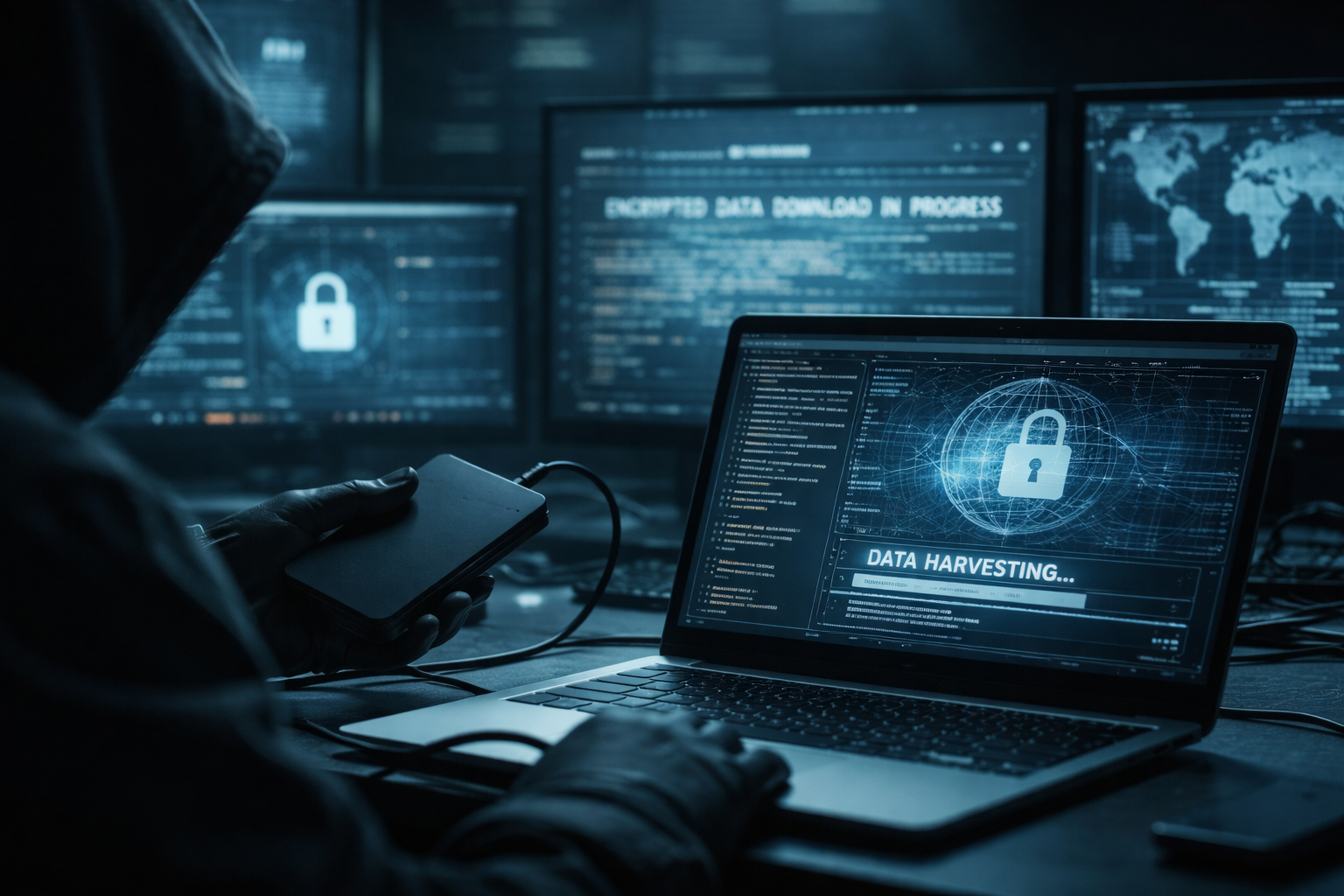
The most serious threats to digital security are not always visible when they matter most. Some of them unfold quietly, over years, without immediate damage or obvious victims. The practice known as Harvest Now, Decrypt Later follows this pattern. Data is collected today, stored patiently, and decrypted in the future when the tools allow it. The danger is not hypothetical. It is already embedded in the system.
Modern encryption is built on assumptions about time and difficulty. Certain mathematical problems are believed to be hard enough that solving them would take longer than the data remains valuable. This logic has held for decades. It now looks less stable. Advances in computing power, combined with progress in quantum research, are shortening timelines that were once considered safe.
The core issue is not whether quantum computers can break current encryption today. They cannot, at least not at scale. The issue is that adversaries do not need them today. They only need access to encrypted data and the ability to store it. Once the data is captured, the clock starts ticking in their favor.
This shifts the threat model in a subtle but important way. Security has traditionally focused on preventing immediate breaches. Firewalls, intrusion detection, and rapid response all assume that the main risk lies in real-time access. Harvest Now, Decrypt Later ignores this logic. It accepts that data may remain unreadable for years. That delay is part of the strategy, not a failure.
Certain types of information are especially exposed. Government communications, intellectual property, health records, and long-term financial data retain value over long periods. For these categories, confidentiality is not a short-term requirement. It is a durable one. Encrypting such data with methods that may fail later introduces a deferred vulnerability that cannot be patched retroactively.
The technology sector has begun to acknowledge this problem, though often in cautious terms. Post-quantum cryptography is discussed as a future upgrade, something to be planned rather than rushed. This framing underplays the asymmetry of the threat. Attackers can act now with relatively low cost. Defenders face high complexity, legacy systems, and uncertain standards.
There is also an institutional lag. Encryption standards are deeply embedded in infrastructure. Changing them is slow and disruptive. Organizations tend to wait for clear mandates or proven consensus. Meanwhile, data continues to accumulate in archives, backups, and cloud storage, encrypted under assumptions that may not hold.
One uncomfortable observation is that much of the world’s sensitive data is being protected by optimism rather than certainty. The belief that current encryption will remain safe long enough is rarely tested against worst-case scenarios. It is accepted because the alternative requires expensive change and admits past exposure.
Looking forward, the likely outcome is uneven adaptation. Some sectors will move early, adopting quantum-resistant methods despite higher costs and performance trade-offs. Others will delay, either through inertia or risk tolerance. This will create a patchwork of security levels, where the weakest links define the overall exposure.
The Harvest Now, Decrypt Later threat also raises questions about trust and disclosure. If data stolen today is only decrypted years later, attribution becomes harder. Accountability fades. Victims may never know when or how their information was compromised. Breaches lose their moment of visibility, even as their impact grows.
This is not a call for panic. Encryption still works. Data is not suddenly readable. But the direction of travel matters. Security is no longer only about defending the present. It is about anticipating future capability and acting before it arrives.
The challenge is conceptual as much as technical. Organizations must accept that secrecy has a lifespan tied to technological progress, not policy intention. Protecting information that must remain private for decades requires thinking in decades, not quarters.
Harvest Now, Decrypt Later does not announce itself with alarms. It operates quietly, methodically, and at scale. By the time its effects are visible, the opportunity to protect the data may already have passed.