


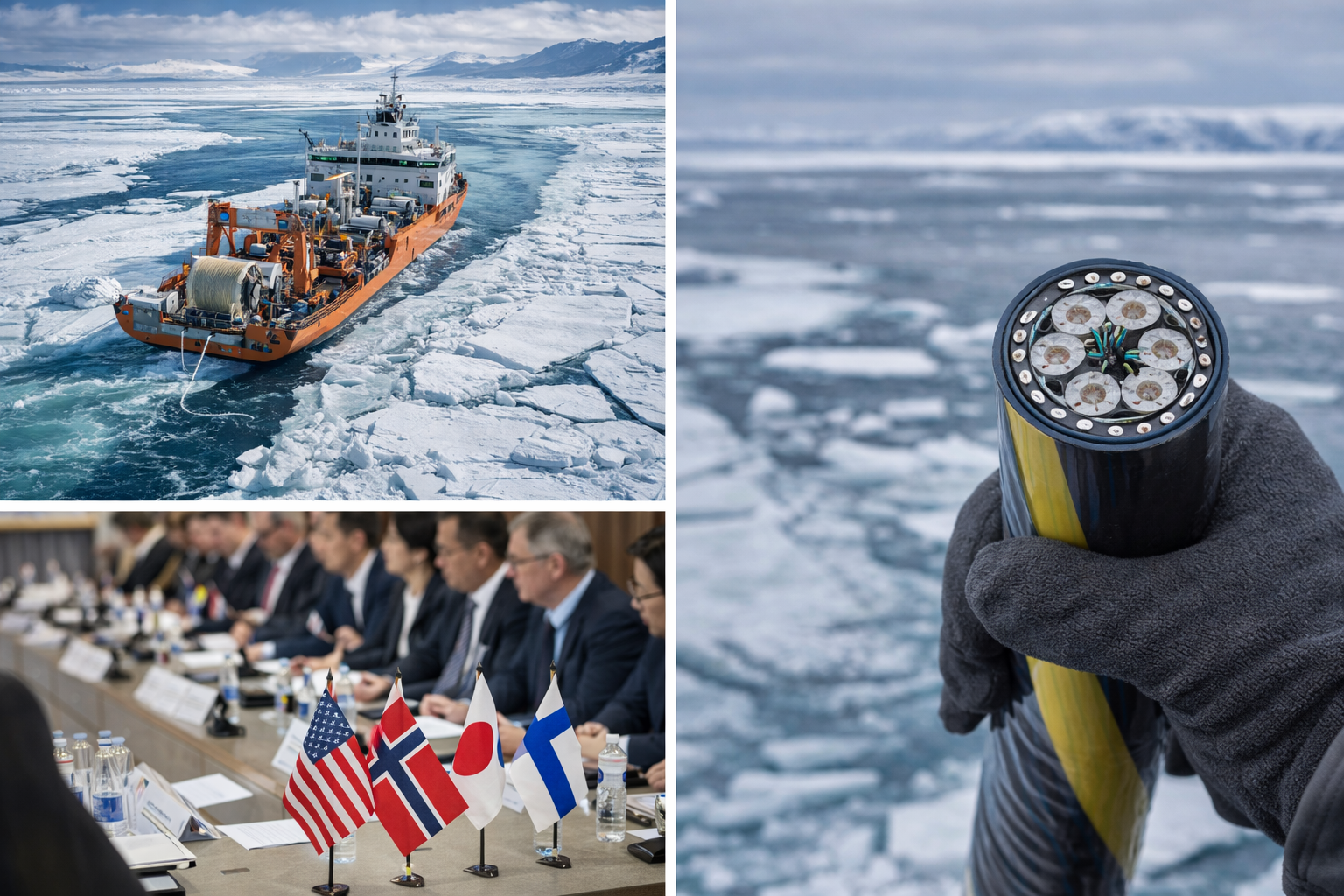
Governments and telecommunications firms in 2026 stepped up discussions over a proposed trans-Arctic subsea cable aimed at linking Europe, Asia and North America through high-speed data connections across the polar region.
Officials from Nordic countries, the United States and Canada confirmed that feasibility studies are under way for new fibre-optic routes that would run along or beneath Arctic seabeds. The project is designed to provide a shorter data path between major financial and technology centres compared with existing cables that pass through the Atlantic, Pacific or via terrestrial corridors.
Current global internet traffic relies heavily on submarine cables laid across established maritime routes. The majority of transcontinental data between Europe and Asia travels through systems that pass the Suez Canal, the Strait of Malacca or across the Pacific Ocean. Industry data show that demand for bandwidth continues to grow due to cloud computing, streaming services and cross-border digital trade.
Supporters of the Arctic initiative say a polar route could reduce latency for certain connections between northern Europe and northeast Asia. Technical assessments released by project partners indicate that advances in cold-climate engineering have improved the viability of cable installation and maintenance in Arctic conditions.
The initiative has drawn attention because of the region’s strategic importance. The Arctic has seen increased military patrols, shipping activity and energy exploration in recent years as ice coverage fluctuates seasonally. Russia maintains an extensive Arctic coastline and infrastructure network, while the United States, Canada and Nordic states have expanded their regional presence.
Diplomatic representatives from involved countries stated that the cable project is focused on civilian telecommunications and commercial connectivity. However, security agencies in several capitals have reviewed the plan in light of broader geopolitical tensions and concerns over critical infrastructure resilience.
China has also signalled interest in Arctic infrastructure through its Polar Silk Road framework, though it is not formally part of the current cable discussions led by Western partners. Analysts note that previous Arctic cable proposals faced delays due to financing gaps and regulatory approvals.
Environmental authorities are reviewing the potential impact of seabed installation and construction activities in fragile Arctic ecosystems. Governments involved have said that environmental assessments will be conducted in line with international maritime conventions and domestic laws.
Telecommunications companies participating in early-stage talks have not announced final investment decisions. Industry representatives said cost estimates, insurance considerations and long-term traffic forecasts will determine whether the project proceeds to construction.
The renewed focus on Arctic connectivity comes as states seek to diversify digital infrastructure routes and reduce reliance on existing choke points. Further technical studies and intergovernmental agreements are expected before any formal construction timeline is announced.