


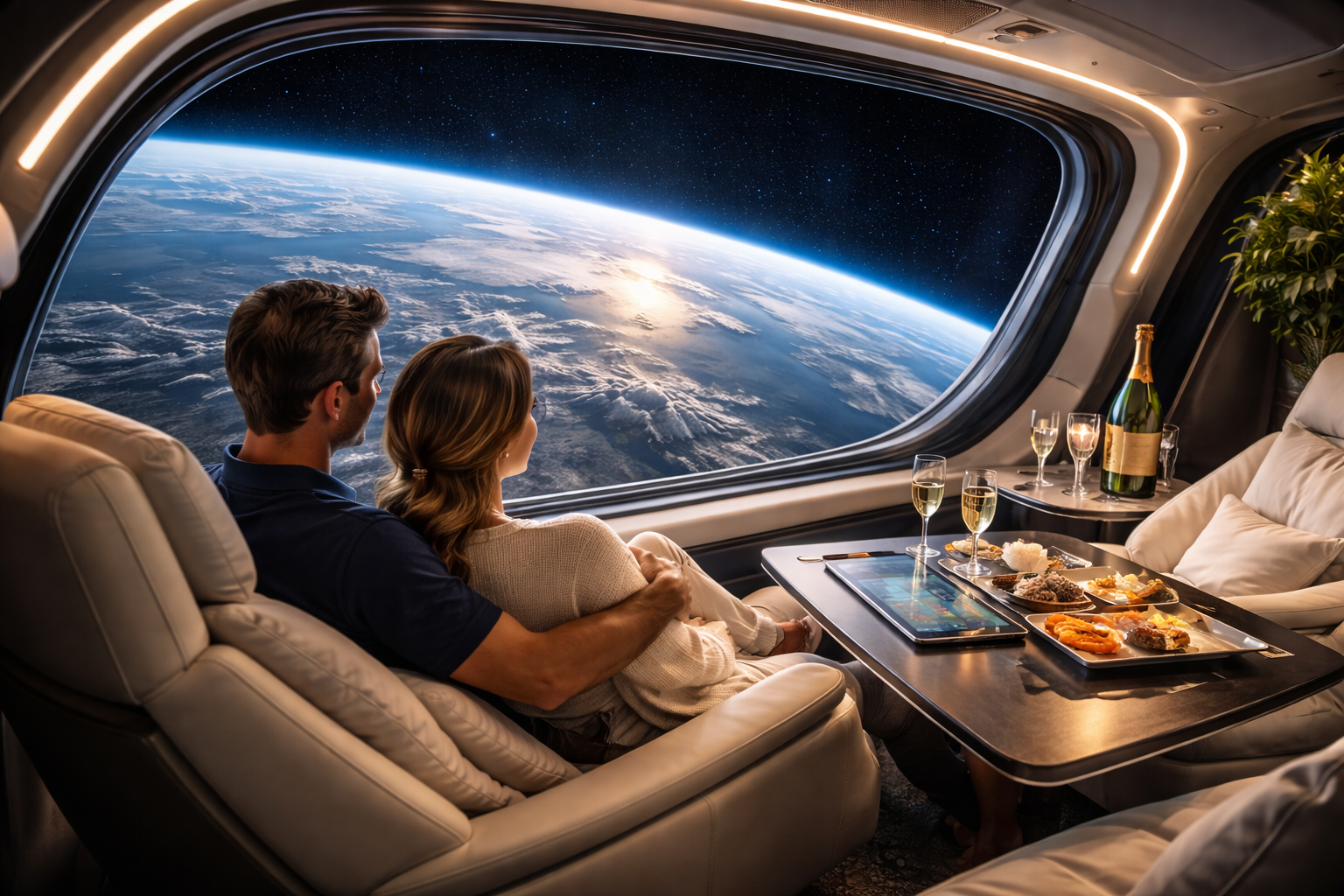
Luxury travel has traditionally been defined by distance and discretion. Private islands, chartered superyachts, remote alpine lodges. The promise was separation from crowds and insulation from friction. That definition is now extending vertically.
A small but visible segment of ultra-high-net-worth individuals is turning toward orbital travel not as spectacle, but as controlled access. Early commercial space flights were framed as technological milestones. What is emerging now is something narrower and more curated: ultra-private missions designed around limited passenger lists, extended preparation cycles, and bespoke orbital experiences.
The appeal is not only altitude. It is exclusivity layered with scarcity. Seats are few. Training is intensive. The experience cannot be replicated through conventional means. In a luxury market saturated with rare objects, orbital travel introduces a form of rarity that is structural rather than branded.
This shift is unfolding quietly. Private aerospace firms are refining shorter orbital stays and high-altitude trajectories that reduce exposure to mass tourism formats. The language surrounding these offerings emphasises privacy, medical screening, and customisation. Participants are not simply ticket holders. They are mission members.
There is also a psychological component. Traditional status symbols are increasingly visible, photographed, and circulated. Orbital travel resists that logic. The experience is difficult to document in conventional ways. The value lies in the moment itself and in the knowledge of access.
Financially, the sums involved remain significant. Yet for individuals accustomed to large capital allocations, the cost sits within a broader lifestyle portfolio. The expense is comparable to major art acquisitions or long-duration yacht charters. The difference is the narrative. Orbital travel signals participation in a threshold moment rather than ownership of a static asset.
The infrastructure supporting this market is evolving in parallel. Private launch facilities are being designed with hospitality suites and extended pre-flight accommodation. Medical and performance teams operate alongside aerospace engineers. The journey begins months before liftoff, with conditioning and simulation sessions that resemble executive retreats more than scientific briefings.
What distinguishes this development from earlier phases of space tourism is the emphasis on discretion. Publicised celebrity flights generated headlines. The current movement appears more selective. Bookings are negotiated privately. Participation is often undisclosed. The voyage is framed less as publicity and more as personal milestone.
There is an emerging alignment between orbital travel and broader shifts in high-end consumption. As visible assets become easier to replicate or finance, experiences that demand physical presence and preparation gain weight. The luxury lies in access to a domain that remains logistically complex and tightly regulated.
This trend also reflects a recalibration of aspiration. For decades, luxury expanded outward across geographies. Now it is probing upward into controlled environments beyond conventional borders. The destination is not a city or coastline. It is orbit.
The market remains small, and technical constraints ensure it will stay that way in the near term. Regulatory oversight, safety protocols, and launch capacity create natural limits. Yet those limits reinforce the appeal. Scarcity is embedded in physics as much as pricing.
Ultra-private orbital travel does not replace traditional high-end tourism. It sits above it, both literally and structurally. It reframes exclusivity around access to altitude and silence, rather than acreage or interior design.
What is becoming visible is not mass adoption, but the early shaping of a new tier within the luxury hierarchy. The final frontier is no longer only symbolic. It is being booked.