


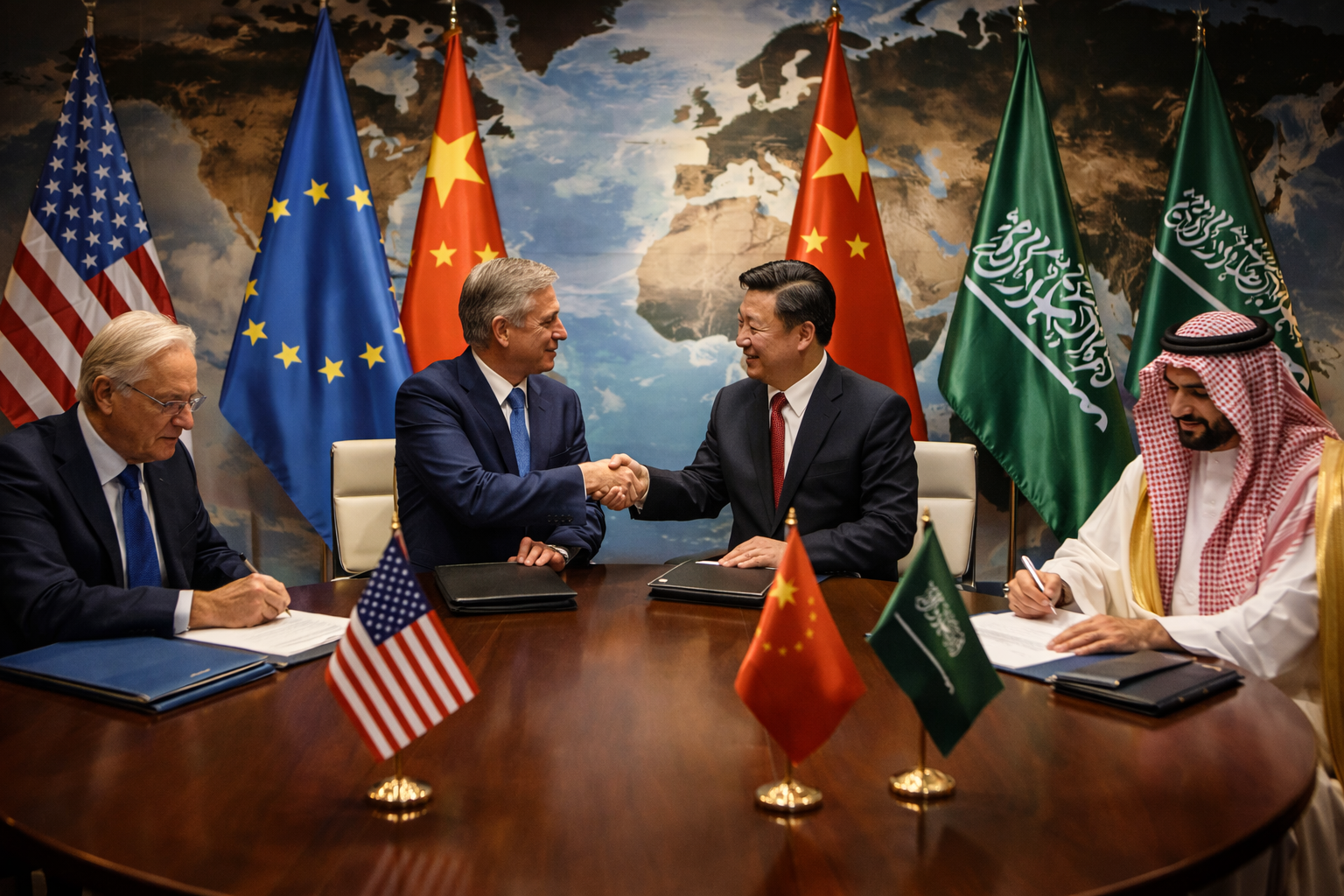
Global power is no longer organised around a single axis. The pattern that is becoming visible is more distributed, more negotiated, and less anchored in fixed alliances. A polycentric structure is taking shape, with influence dispersed across regional blocs and issue-based coalitions.
Within this environment, the United States is adjusting its external posture in ways that appear increasingly transactional. Security guarantees, trade access, technology transfers, and energy cooperation are being framed less as durable commitments and more as contingent arrangements tied to specific outcomes.
This does not represent withdrawal. It represents recalibration. Long-standing partnerships are being reviewed through the lens of cost, reciprocity, and strategic leverage. The language of shared values remains present, but it is often accompanied by explicit discussions of burden sharing and conditional support.
The shift is visible in trade negotiations that prioritise domestic industry, in security arrangements that emphasise financial contributions from partners, and in diplomatic engagements structured around discrete deals rather than broad multilateral consensus. Engagement becomes modular.
At the same time, other centres of power are expanding their own regional influence. Middle powers are deepening ties within neighbouring markets. Cross-border infrastructure corridors are advancing without waiting for global frameworks. Currency arrangements and payment systems are being explored outside traditional channels. Influence is being built through networks rather than hierarchies.
This diffusion creates space for strategic flexibility. Countries that once aligned automatically with one pole are diversifying relationships. Economic and security alignments are no longer perfectly overlapping. A state may rely on one partner for defence technology, another for trade, and a third for energy investment.
American transactionalism interacts with this environment in complex ways. On one level, it accelerates diversification. When commitments are presented as conditional, counterparts seek alternative options. On another level, it reinforces the centrality of U.S. leverage in finance, technology, and military capability. Deals may be narrower, but they remain consequential.
The financial dimension is particularly telling. Sanctions, export controls, and investment screening have become routine instruments of policy. Their application signals that economic interdependence is a tool of power. In response, affected states experiment with parallel arrangements. The result is not fragmentation into isolation, but a layered system of overlapping structures.
Energy markets provide a parallel example. Supply agreements are increasingly shaped by short-term pricing and security considerations. Long-term integration gives way to flexible sourcing. Liquefied natural gas contracts, renewable technology partnerships, and mineral supply chains are negotiated with explicit attention to strategic positioning.
What distinguishes the current moment is the coexistence of integration and hedging. Trade volumes remain substantial. Financial markets remain interconnected. Yet governments are embedding contingency into agreements. The architecture of global power becomes less rigid.
In such a landscape, influence depends less on formal blocs and more on the ability to broker transactions across domains. Military strength, financial depth, and technological leadership continue to matter. But so does agility.
The polycentric shift does not imply equal distribution of power. It implies multiple centres capable of shaping outcomes within defined spheres. American policy, by foregrounding reciprocity and deal-making, adapts to that reality while also shaping it.
What is emerging is a global system defined less by stable polarity and more by negotiated positioning. Commitments are framed in terms of measurable exchange. Partnerships are structured around deliverables.
The transformation is incremental, not abrupt. Yet the cumulative effect is visible. Power is still concentrated, but its expression is increasingly transactional and dispersed across a network of active centres.