


Close Menu
Briefory
    What's Hot

    The Sovereignty of the Self in an Age of Algorithmic Governance

    13.02.2026

    The Chronos Strategy and the Death of the Always-On Executive Culture

    13.02.2026

    Direct Indexing and the Democratization of Tax-Loss Harvesting for High-Net-Worth Portfolios

    13.02.2026
    Facebook X (Twitter) Instagram
    Trending
    • The Sovereignty of the Self in an Age of Algorithmic Governance
    • The Chronos Strategy and the Death of the Always-On Executive Culture
    • Direct Indexing and the Democratization of Tax-Loss Harvesting for High-Net-Worth Portfolios
    • The Fragmentation Gamble and the Rise of Issue-Based Partnerships in the Global South
    • The Polycentric Shift and Why American Transactionalism is Redefining Global Power Dynamics in 2026
    • The Neuro-Symbolic Pivot and Why Pure Neural Networks are Reaching a Reasoning Ceiling
    • Trans-Arctic Cable Initiative Gains Momentum Amid Strategic Rivalry
    • Beyond Silicon and the Commercial Viability of Diamond-Based Power Electronics
    Facebook X (Twitter) Instagram
    BrieforyBriefory
    Sunday, April 19
    • World
      • Americas
      • Europe
      • Asia-Pacific
      • Africa
      • Middle East
    • Economy & Business
      • Global Economy
      • Real Estate
      • Startups
    • Finance & Markets
      • Stock Market
      • Crypto & Web3
      • Commodities
      • Forex
    • Health & Biohacking
      • Longevity
      • Mental Wellness
      • Medical Breakthroughs
    • Lifestyle & Luxury
      • High-End Travel
      • Sustainable Living
      • Work-Life Balance
    • Personal Finance
      • Global Tax & Equity
      • Retirement Planning
      • Wealth Management
    • Perspectives
      • Expert Briefings
      • Future Trends
      • Global Opinions
    • Tech & AI
      • Artificial Intelligence
      • Cyber Security
      • Future Tech
    • The Brief
      • Daily Briefings
      • Tech Radar
      • Deep Dives
    Briefory
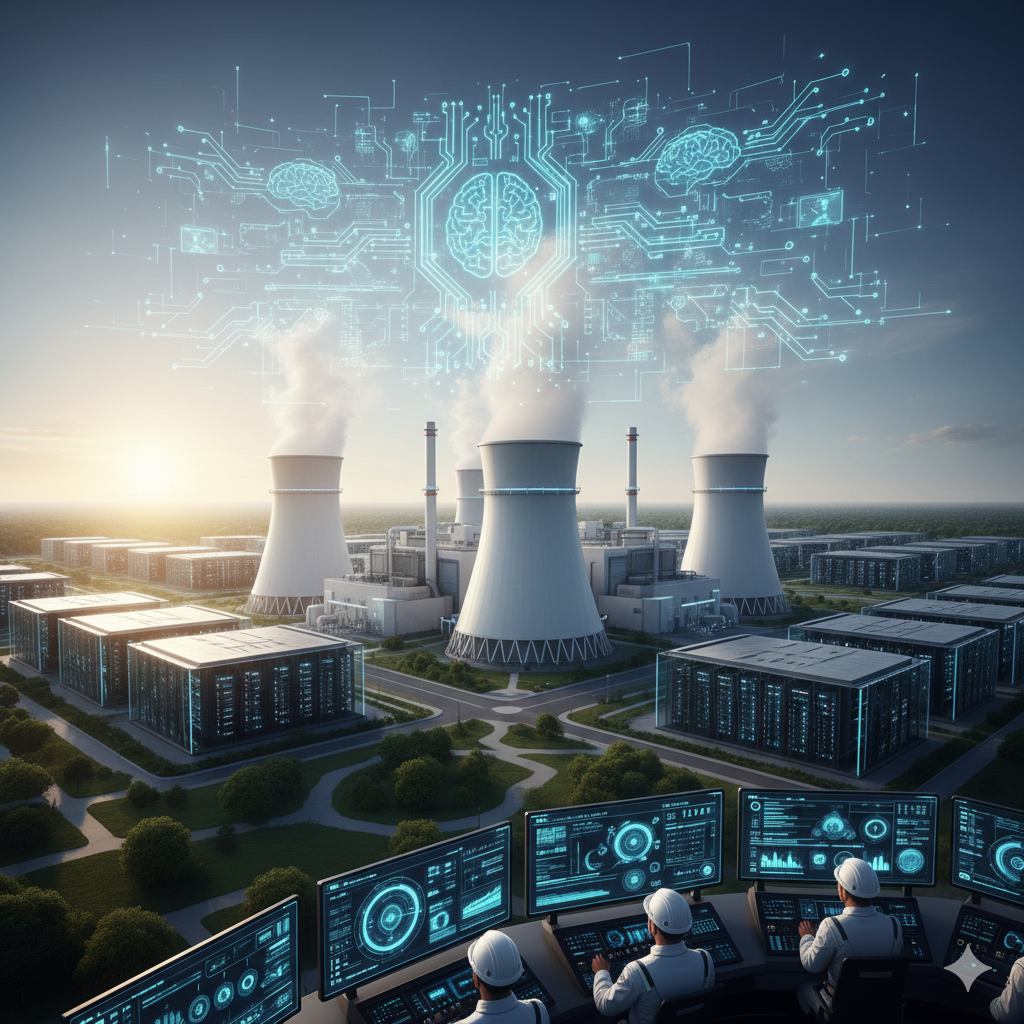
    A modern nuclear power plant integrated with a massive AI data center complex at sunset, featuring digital holographic overlays of neural networks and control room monitors illustrating the fusion of nuclear energy and artificial intelligence.

    Uranium and the Nuclear Foundation of the Digital Economy

    0
    By Briefory Intelligence on 04.02.2026 Commodities, Finance & Markets
    Share
    Facebook Twitter LinkedIn Copy Link

    In 2026, the global energy conversation has entered a new phase. The focus has shifted away from intermittent generation and toward reliability, continuity, and scale. At the center of this transition lies an unambiguous reality: the rapid expansion of artificial intelligence infrastructure has created energy demands that cannot be met by renewables alone.

    As AI data centers multiply across North America, Europe, and Asia, energy consumption is no longer measured in incremental growth. It is structural, continuous, and non-negotiable. This has forced governments, utilities, and technology firms to reassess the foundations of energy security. In that reassessment, uranium has re-emerged as a strategic commodity of first order importance.

    Nuclear power provides what the digital economy increasingly requires: constant baseload generation, high energy density, and minimal land footprint. Unlike wind and solar, nuclear generation does not fluctuate with weather or daylight. For data centers operating around the clock, stability is not a preference. It is an operational requirement.

    This shift has exposed long-standing imbalances in the uranium market. For more than a decade following the Fukushima accident, uranium prices remained suppressed, discouraging investment in new mining capacity. Production was curtailed, projects were delayed, and inventories were gradually drawn down. That period of underinvestment has now collided with renewed demand.

    By 2026, uranium supply is structurally constrained. Reactors that were once idled are returning to service, particularly in Europe and parts of Asia. At the same time, new capacity is being planned to support electrification and digital infrastructure growth. The result is a market where demand visibility has improved faster than supply responsiveness.

    From a Briefory Intelligence perspective, this represents a classic inflection point. Uranium is not traded like oil or natural gas. Contracts are long-term, opaque, and relationship-driven. Spot prices capture only part of the story. What matters more is access.

    This has led to a notable development: direct procurement agreements between technology firms and uranium producers. Hyperscale data center operators are increasingly treating energy supply as a strategic input rather than a utility expense. Securing long-term nuclear power access has become part of infrastructure planning, alongside land, connectivity, and cooling.

    Geopolitics further complicates the picture. Uranium supply chains are highly concentrated. Mining, enrichment, and fuel fabrication often occur in different jurisdictions, each with its own regulatory and political risks. As energy security becomes a national priority, governments are reassessing their exposure to external suppliers.

    This has accelerated efforts to localize or diversify nuclear fuel cycles. Friendly jurisdictions with stable regulatory environments are gaining strategic relevance. In parallel, investment is flowing into domestic enrichment and conversion capacity, areas that were previously overlooked during years of low demand.

    A defining feature of the current nuclear revival is the rise of Small Modular Reactors. SMRs offer flexibility that traditional large-scale plants cannot. They can be deployed closer to consumption centers, scaled incrementally, and integrated with industrial or digital facilities. For AI data centers, this opens the possibility of dedicated, on-site or near-site nuclear generation.

    While widespread deployment remains several years away, capital allocation has already shifted. The nuclear renaissance of 2026 is less about headline megaprojects and more about modularity, predictability, and resilience.

    From an investment standpoint, uranium has transitioned from a cyclical commodity to a strategic allocation. Institutional investors are increasingly viewing exposure to the nuclear fuel cycle as a hedge against energy instability and grid congestion. Unlike fossil fuels, uranium demand is driven by long-term policy commitments and infrastructure lock-in.

    Environmental considerations also play a role. As governments pursue decarbonization targets, nuclear energy has regained political acceptance as a low-carbon solution capable of operating at scale. For energy-intensive digital infrastructure, this alignment between climate objectives and operational necessity is critical.

    The broader implication is clear. The digital economy rests on physical foundations. Data, algorithms, and artificial intelligence may appear abstract, but they depend on uninterrupted power. In 2026, that power increasingly comes from nuclear reactors fueled by uranium.

    The strategic significance of uranium lies not in speculation, but in inevitability. As long as AI infrastructure continues to expand, the demand for stable baseload energy will grow alongside it. In that equation, uranium is no longer a peripheral commodity. It is a cornerstone.

    The future of the digital economy will not be powered solely by innovation in software. It will be underwritten by materials that can deliver energy at scale, without interruption. Uranium now sits firmly within that category.

    Keep Reading

    Institutional Liquidity and the Institutionalization of Decentralized Finance Protocols

    Rare Earth Producers Accelerate Push for Independent Supply Chains in 2026

    The Institutional Pivot to On-chain Liquidity and the Institutionalization of DeFi

    The Copper Supply Crunch and the Geopolitics of the Electric Grid Upgrade

    The Rare Earth Renaissance and the New Geopolitics of Luxury Electronics

    Global Central Banks Launch Interoperability Bridge for Sovereign CBDCs

    Leave A Reply Cancel Reply

    Latest Posts
    Advertisement
    Demo

    Recent Posts

    • The Sovereignty of the Self in an Age of Algorithmic Governance
    • The Chronos Strategy and the Death of the Always-On Executive Culture
    • Direct Indexing and the Democratization of Tax-Loss Harvesting for High-Net-Worth Portfolios
    • The Fragmentation Gamble and the Rise of Issue-Based Partnerships in the Global South
    • The Polycentric Shift and Why American Transactionalism is Redefining Global Power Dynamics in 2026
    Facebook X (Twitter) WhatsApp TikTok Instagram

    News

    • World News
    • Politics
    • Business
    • Technology

    Company

    • Privacy & Policy
    • Editorial Policy
    • Copyright & DMCA Policy
    • Terms of Use

    Contact

    • Contact
    • About Briefory

    Stay Informed. Stay Briefed.

    Essential global news, carefully selected and delivered by Briefory

    © 2026 Briefory.com Designed & Developed by lv8 – Consulting.
    • Privacy Policy
    • Terms
    • Copyright & DMCA Policy

    Type above and press Enter to search. Press Esc to cancel.

    Your privacy settings

    We and our partners use information collected through cookies and similar technologies to improve your experience on our site, analyse how you use it and for marketing purposes. Because we respect your right to privacy, you can choose not to allow some types of cookies. However, blocking some types of cookies may impact your experience of the site and the services we are able to offer. In some cases, data obtained from cookies is shared with third parties for analytics or marketing reasons. You can exercise your right to opt-out of that sharing at any time by disabling cookies.
    Privacy Policy

    Manage Consent Preferences

    Necessary

    Always ON
    These cookies and scripts are necessary for the website to function and cannot be switched off. They are usually only set in response to actions made by you which amount to a request for services, suchas setting your privacy preferences, logging in or filling in forms. You can set your browser to block oralert you about these cookies, but some parts of the site will not then work. These cookies do not store any personally identifiable information.

    Analytics

    These cookies and scripts allow us to count visits and traffic sources, so we can measure and improve the performance of our site. They help us know which pages are the most and least popular and see how visitors move around the site. All information these cookies collect is aggregated and therefore anonymous. If you do not allow these cookies and scripts, we will not know when you have visited our site.

    Embedded Videos

    These cookies and scripts may be set through our site by external video hosting services likeYouTube or Vimeo. They may be used to deliver video content on our website. It’s possible for the video provider to build a profile of your interests and show you relevant adverts on this or other websites. They do not store directly personal information, but are based on uniquely identifying your browser and internet device. If you do not allow these cookies or scripts it is possible that embedded video will not function as expected.

    Google Fonts

    Google Fonts is a font embedding service library. Google Fonts are stored on Google's CDN. The Google Fonts API is designed to limit the collection, storage, and use of end-user data to only what is needed to serve fonts efficiently. Use of Google Fonts API is unauthenticated. No cookies are sent by website visitors to the Google Fonts API. Requests to the Google Fonts API are made to resource-specific domains, such as fonts.googleapis.com or fonts.gstatic.com. This means your font requests are separate from and don't contain any credentials you send to google.com while using other Google services that are authenticated, such as Gmail.

    Marketing

    These cookies and scripts may be set through our site by our advertising partners. They may be used by those companies to build a profile of your interests and show you relevant adverts on other sites. They do not store directly personal information, but are based on uniquely identifying your browser and internet device. If you do not allow these cookies and scripts, you will experience less targeted advertising.
    Disable all Confirm my choices Allow all
    Verified by ConsentMagic
    My Consent Preferences