

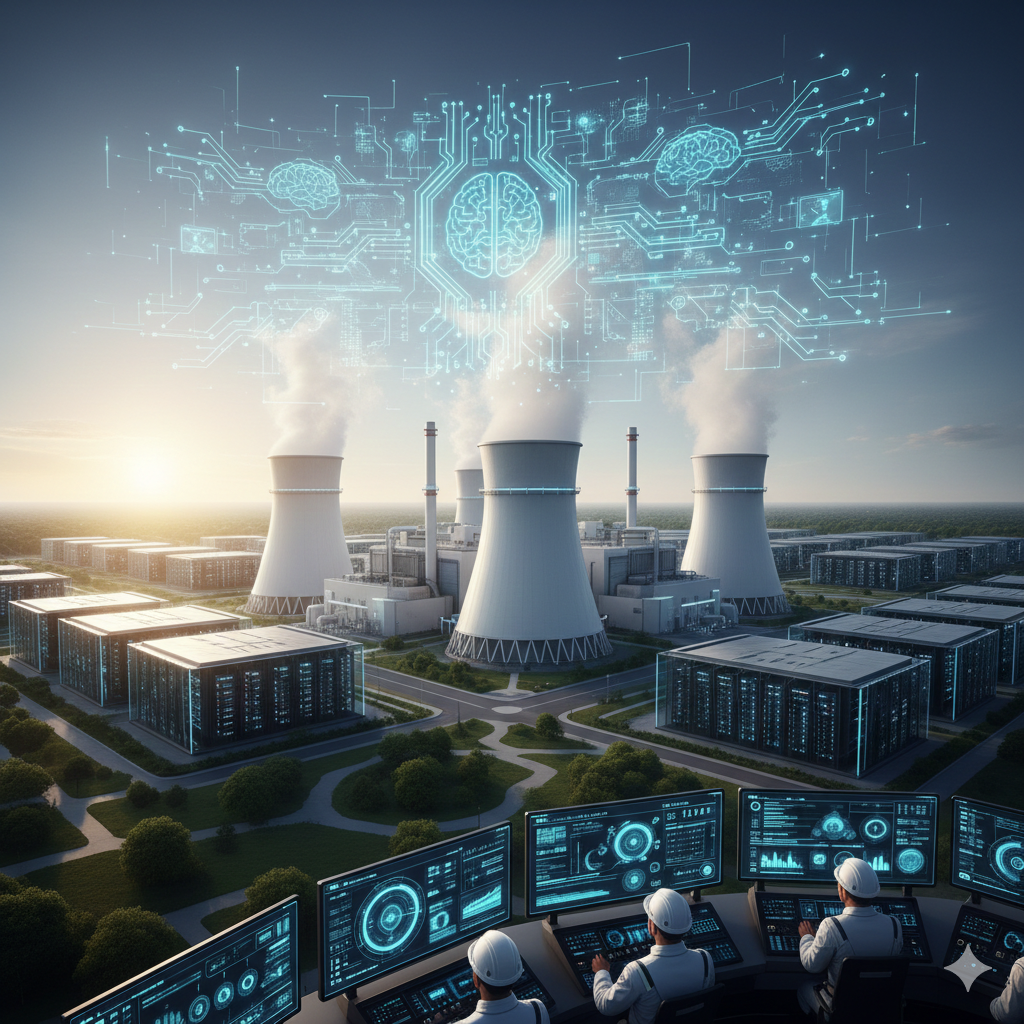
In 2026, the global energy conversation has entered a new phase. The focus has shifted away from intermittent generation and toward reliability, continuity, and scale. At the center of this transition lies an unambiguous reality: the rapid expansion of artificial intelligence infrastructure has created energy demands that cannot be met by renewables alone.
As AI data centers multiply across North America, Europe, and Asia, energy consumption is no longer measured in incremental growth. It is structural, continuous, and non-negotiable. This has forced governments, utilities, and technology firms to reassess the foundations of energy security. In that reassessment, uranium has re-emerged as a strategic commodity of first order importance.
Nuclear power provides what the digital economy increasingly requires: constant baseload generation, high energy density, and minimal land footprint. Unlike wind and solar, nuclear generation does not fluctuate with weather or daylight. For data centers operating around the clock, stability is not a preference. It is an operational requirement.
This shift has exposed long-standing imbalances in the uranium market. For more than a decade following the Fukushima accident, uranium prices remained suppressed, discouraging investment in new mining capacity. Production was curtailed, projects were delayed, and inventories were gradually drawn down. That period of underinvestment has now collided with renewed demand.
By 2026, uranium supply is structurally constrained. Reactors that were once idled are returning to service, particularly in Europe and parts of Asia. At the same time, new capacity is being planned to support electrification and digital infrastructure growth. The result is a market where demand visibility has improved faster than supply responsiveness.
From a Briefory Intelligence perspective, this represents a classic inflection point. Uranium is not traded like oil or natural gas. Contracts are long-term, opaque, and relationship-driven. Spot prices capture only part of the story. What matters more is access.
This has led to a notable development: direct procurement agreements between technology firms and uranium producers. Hyperscale data center operators are increasingly treating energy supply as a strategic input rather than a utility expense. Securing long-term nuclear power access has become part of infrastructure planning, alongside land, connectivity, and cooling.
Geopolitics further complicates the picture. Uranium supply chains are highly concentrated. Mining, enrichment, and fuel fabrication often occur in different jurisdictions, each with its own regulatory and political risks. As energy security becomes a national priority, governments are reassessing their exposure to external suppliers.
This has accelerated efforts to localize or diversify nuclear fuel cycles. Friendly jurisdictions with stable regulatory environments are gaining strategic relevance. In parallel, investment is flowing into domestic enrichment and conversion capacity, areas that were previously overlooked during years of low demand.
A defining feature of the current nuclear revival is the rise of Small Modular Reactors. SMRs offer flexibility that traditional large-scale plants cannot. They can be deployed closer to consumption centers, scaled incrementally, and integrated with industrial or digital facilities. For AI data centers, this opens the possibility of dedicated, on-site or near-site nuclear generation.
While widespread deployment remains several years away, capital allocation has already shifted. The nuclear renaissance of 2026 is less about headline megaprojects and more about modularity, predictability, and resilience.
From an investment standpoint, uranium has transitioned from a cyclical commodity to a strategic allocation. Institutional investors are increasingly viewing exposure to the nuclear fuel cycle as a hedge against energy instability and grid congestion. Unlike fossil fuels, uranium demand is driven by long-term policy commitments and infrastructure lock-in.
Environmental considerations also play a role. As governments pursue decarbonization targets, nuclear energy has regained political acceptance as a low-carbon solution capable of operating at scale. For energy-intensive digital infrastructure, this alignment between climate objectives and operational necessity is critical.
The broader implication is clear. The digital economy rests on physical foundations. Data, algorithms, and artificial intelligence may appear abstract, but they depend on uninterrupted power. In 2026, that power increasingly comes from nuclear reactors fueled by uranium.
The strategic significance of uranium lies not in speculation, but in inevitability. As long as AI infrastructure continues to expand, the demand for stable baseload energy will grow alongside it. In that equation, uranium is no longer a peripheral commodity. It is a cornerstone.
The future of the digital economy will not be powered solely by innovation in software. It will be underwritten by materials that can deliver energy at scale, without interruption. Uranium now sits firmly within that category.