

Close Menu
Briefory
    What's Hot

    The Sovereignty of the Self in an Age of Algorithmic Governance

    13.02.2026

    The Chronos Strategy and the Death of the Always-On Executive Culture

    13.02.2026

    Direct Indexing and the Democratization of Tax-Loss Harvesting for High-Net-Worth Portfolios

    13.02.2026
    Facebook X (Twitter) Instagram
    Trending
    • The Sovereignty of the Self in an Age of Algorithmic Governance
    • The Chronos Strategy and the Death of the Always-On Executive Culture
    • Direct Indexing and the Democratization of Tax-Loss Harvesting for High-Net-Worth Portfolios
    • The Fragmentation Gamble and the Rise of Issue-Based Partnerships in the Global South
    • The Polycentric Shift and Why American Transactionalism is Redefining Global Power Dynamics in 2026
    • The Neuro-Symbolic Pivot and Why Pure Neural Networks are Reaching a Reasoning Ceiling
    • Trans-Arctic Cable Initiative Gains Momentum Amid Strategic Rivalry
    • Beyond Silicon and the Commercial Viability of Diamond-Based Power Electronics
    Facebook X (Twitter) Instagram
    BrieforyBriefory
    Sunday, April 19
    • World
      • Americas
      • Europe
      • Asia-Pacific
      • Africa
      • Middle East
    • Economy & Business
      • Global Economy
      • Real Estate
      • Startups
    • Finance & Markets
      • Stock Market
      • Crypto & Web3
      • Commodities
      • Forex
    • Health & Biohacking
      • Longevity
      • Mental Wellness
      • Medical Breakthroughs
    • Lifestyle & Luxury
      • High-End Travel
      • Sustainable Living
      • Work-Life Balance
    • Personal Finance
      • Global Tax & Equity
      • Retirement Planning
      • Wealth Management
    • Perspectives
      • Expert Briefings
      • Future Trends
      • Global Opinions
    • Tech & AI
      • Artificial Intelligence
      • Cyber Security
      • Future Tech
    • The Brief
      • Daily Briefings
      • Tech Radar
      • Deep Dives
    Briefory
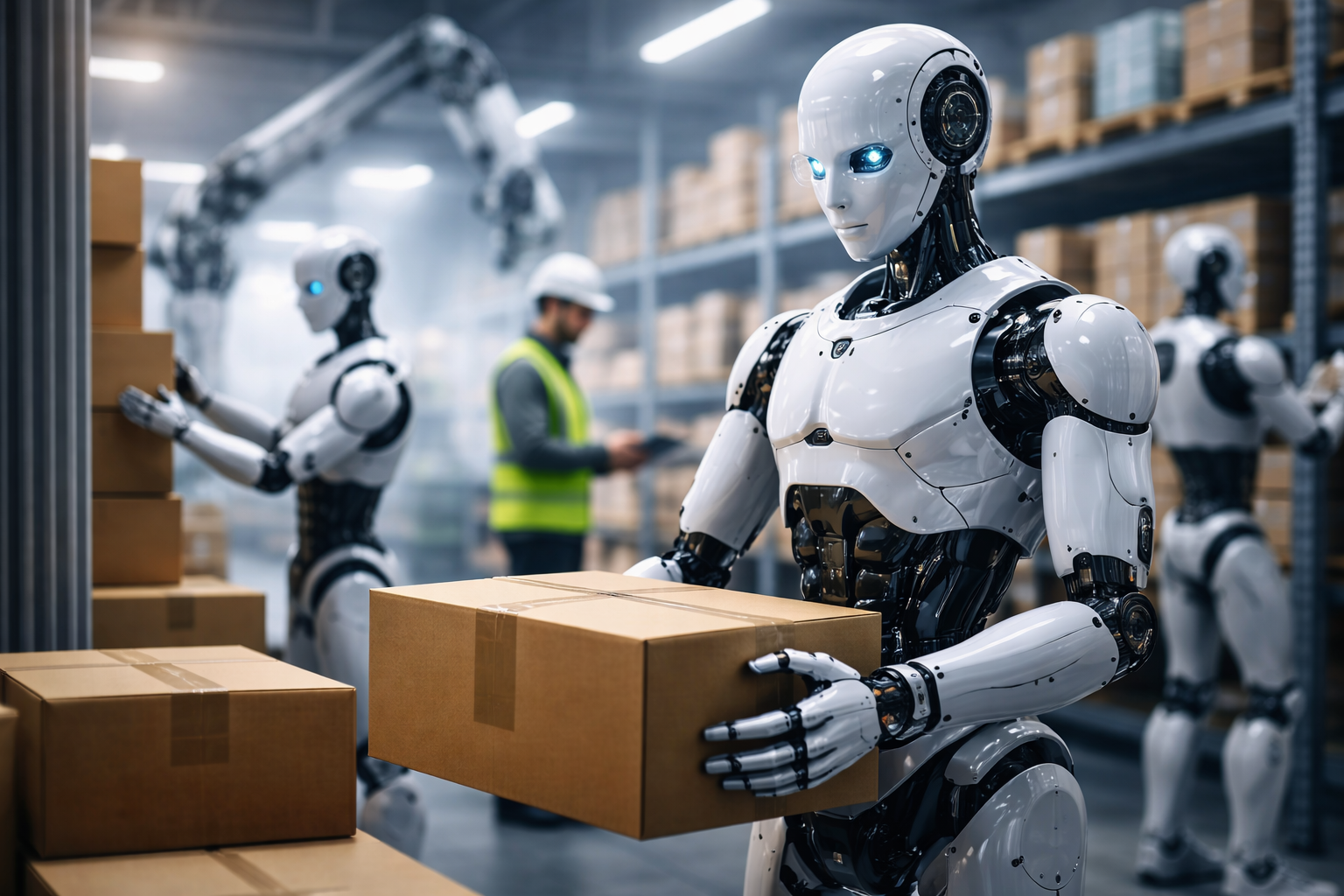
    Humanoid robots handle packages inside a warehouse environment, illustrating AI systems operating autonomously in physical space alongside human oversight.

    The Embodiment Breakthrough and the Rise of General Purpose Physical Agents

    0
    By Analysis on 11.02.2026 Tech Radar, The Brief
    Share
    Facebook Twitter LinkedIn Copy Link

    For much of its recent history, artificial intelligence lived behind glass. It processed language, images, and numbers, but remained detached from the physical world it described. This separation shaped both expectations and limits. Intelligence was fast, cheap, and abstract. Action stayed human.

    That boundary is starting to erode. Advances in robotics, sensing, and machine learning are pushing AI systems out of screens and into bodies. The result is a new class of systems often described as general purpose physical agents. They are not built for a single task. They are designed to move, perceive, adapt, and act across environments that were once considered too messy for automation.

    The significance of embodiment is easy to understate. Physical presence changes what intelligence means. A system that can touch, lift, walk, and navigate must deal with friction, uncertainty, and consequence in real time. Errors are no longer contained in logs. They play out in space. This forces a different kind of learning.

    Until recently, robots were narrow by necessity. They operated in controlled settings, repeating fixed motions. Any deviation required reprogramming. What is changing now is the coupling between perception and action. Systems learn not only from instruction but from interaction. They build internal models by doing, failing, and adjusting.

    This shift has been enabled by several converging trends. Sensors have become cheaper and more precise. Simulation environments allow millions of trial runs before hardware is deployed. Learning architectures can transfer skills from one context to another. None of these is new on its own. Together, they alter the trajectory.

    General purpose physical agents are still limited. They move slowly. They fail often. They require supervision. But their direction matters more than their current capability. Unlike task-specific machines, these agents improve through exposure. A robot that learns to grasp objects today may adapt that skill to tools tomorrow. Progress compounds.

    The economic implications are uneven. Physical labor has long resisted automation because it demands flexibility. Warehouses, hospitals, farms, and construction sites vary too much for rigid machines. Embodied agents aim to narrow that gap. Not by perfect planning, but by tolerating variation.

    This does not mean widespread replacement is imminent. Human dexterity and judgment remain hard to replicate. Yet even partial substitution changes cost structures. A system that handles only the most repetitive or hazardous tasks reshapes job design around it. Work fragments. Roles shift.

    There is also a strategic dimension. Software-based AI scaled through distribution. Physical agents scale through manufacturing. This introduces friction. Hardware takes time. It breaks. It must be maintained. These constraints slow diffusion but also create defensibility. Once deployed, embodied systems are harder to displace than code.

    One uncomfortable observation is that society has less practice governing physical autonomy than digital autonomy. When an algorithm misclassifies data, the harm is indirect. When a machine acts in shared space, the risk is immediate. Responsibility becomes tangible. Liability is harder to abstract.

    Regulation is beginning to notice, though often late. Existing frameworks assume clear separation between tools and operators. General purpose agents blur that line. They act with delegated authority, but without full predictability. Oversight becomes a question of thresholds rather than commands.

    The term general purpose itself deserves caution. These systems are not general in the human sense. They do not understand goals or values beyond their training. Their flexibility is bounded by experience and design. Overstating autonomy invites backlash when limits appear.

    Still, embodiment marks a break from prior waves of automation. Earlier systems replaced specific functions. These agents aim to occupy space, interact continuously, and learn across tasks. That ambition carries risk, but also potential.

    In the near term, adoption will likely concentrate where constraints are tight and margins matter. Logistics, elder care support, inspection, and remote operations are early candidates. In these settings, even modest gains justify experimentation.

    The longer-term question is not whether general purpose physical agents succeed, but how they integrate. Will they remain peripheral assistants, or become central actors in daily operations. The answer depends less on engineering than on trust, economics, and tolerance for failure.

    Embodiment forces a reckoning. Intelligence that acts must be managed differently than intelligence that advises. As AI gains bodies, abstraction gives way to presence. The systems are slower, heavier, and more visible. Their mistakes are harder to ignore.

    The breakthrough is not that machines can move. It is that learning is no longer confined to representation. Action becomes part of cognition. Once that loop is established, the pace of change follows a different curve. Not exponential, perhaps, but persistent.

    General purpose physical agents will arrive unevenly. They will frustrate expectations before meeting them. Yet their emergence signals a shift that is difficult to reverse. Intelligence is leaving the screen. The world will have to make room for it.

    Keep Reading

    Trans-Arctic Cable Initiative Gains Momentum Amid Strategic Rivalry

    Beyond Silicon and the Commercial Viability of Diamond-Based Power Electronics

    The Great Semiconductor Reshoring and the Geometric Logic of the New Industrial Clusters

    Japan and Kawasaki Agree Contract for Large Liquefied Hydrogen Carrier

    The Post-Silicon Transition and the Commercialization of Graphene Semiconductors

    The Subsea Vulnerability and the Great Decoupling of the Global Internet

    Leave A Reply Cancel Reply

    Latest Posts
    Advertisement
    Demo

    Recent Posts

    • The Sovereignty of the Self in an Age of Algorithmic Governance
    • The Chronos Strategy and the Death of the Always-On Executive Culture
    • Direct Indexing and the Democratization of Tax-Loss Harvesting for High-Net-Worth Portfolios
    • The Fragmentation Gamble and the Rise of Issue-Based Partnerships in the Global South
    • The Polycentric Shift and Why American Transactionalism is Redefining Global Power Dynamics in 2026
    Facebook X (Twitter) WhatsApp TikTok Instagram

    News

    • World News
    • Politics
    • Business
    • Technology

    Company

    • Privacy & Policy
    • Editorial Policy
    • Copyright & DMCA Policy
    • Terms of Use

    Contact

    • Contact
    • About Briefory

    Stay Informed. Stay Briefed.

    Essential global news, carefully selected and delivered by Briefory

    © 2026 Briefory.com Designed & Developed by lv8 – Consulting.
    • Privacy Policy
    • Terms
    • Copyright & DMCA Policy

    Type above and press Enter to search. Press Esc to cancel.

    Your privacy settings

    We and our partners use information collected through cookies and similar technologies to improve your experience on our site, analyse how you use it and for marketing purposes. Because we respect your right to privacy, you can choose not to allow some types of cookies. However, blocking some types of cookies may impact your experience of the site and the services we are able to offer. In some cases, data obtained from cookies is shared with third parties for analytics or marketing reasons. You can exercise your right to opt-out of that sharing at any time by disabling cookies.
    Privacy Policy

    Manage Consent Preferences

    Necessary

    Always ON
    These cookies and scripts are necessary for the website to function and cannot be switched off. They are usually only set in response to actions made by you which amount to a request for services, suchas setting your privacy preferences, logging in or filling in forms. You can set your browser to block oralert you about these cookies, but some parts of the site will not then work. These cookies do not store any personally identifiable information.

    Analytics

    These cookies and scripts allow us to count visits and traffic sources, so we can measure and improve the performance of our site. They help us know which pages are the most and least popular and see how visitors move around the site. All information these cookies collect is aggregated and therefore anonymous. If you do not allow these cookies and scripts, we will not know when you have visited our site.

    Embedded Videos

    These cookies and scripts may be set through our site by external video hosting services likeYouTube or Vimeo. They may be used to deliver video content on our website. It’s possible for the video provider to build a profile of your interests and show you relevant adverts on this or other websites. They do not store directly personal information, but are based on uniquely identifying your browser and internet device. If you do not allow these cookies or scripts it is possible that embedded video will not function as expected.

    Google Fonts

    Google Fonts is a font embedding service library. Google Fonts are stored on Google's CDN. The Google Fonts API is designed to limit the collection, storage, and use of end-user data to only what is needed to serve fonts efficiently. Use of Google Fonts API is unauthenticated. No cookies are sent by website visitors to the Google Fonts API. Requests to the Google Fonts API are made to resource-specific domains, such as fonts.googleapis.com or fonts.gstatic.com. This means your font requests are separate from and don't contain any credentials you send to google.com while using other Google services that are authenticated, such as Gmail.

    Marketing

    These cookies and scripts may be set through our site by our advertising partners. They may be used by those companies to build a profile of your interests and show you relevant adverts on other sites. They do not store directly personal information, but are based on uniquely identifying your browser and internet device. If you do not allow these cookies and scripts, you will experience less targeted advertising.
    Disable all Confirm my choices Allow all
    Verified by ConsentMagic
    My Consent Preferences