

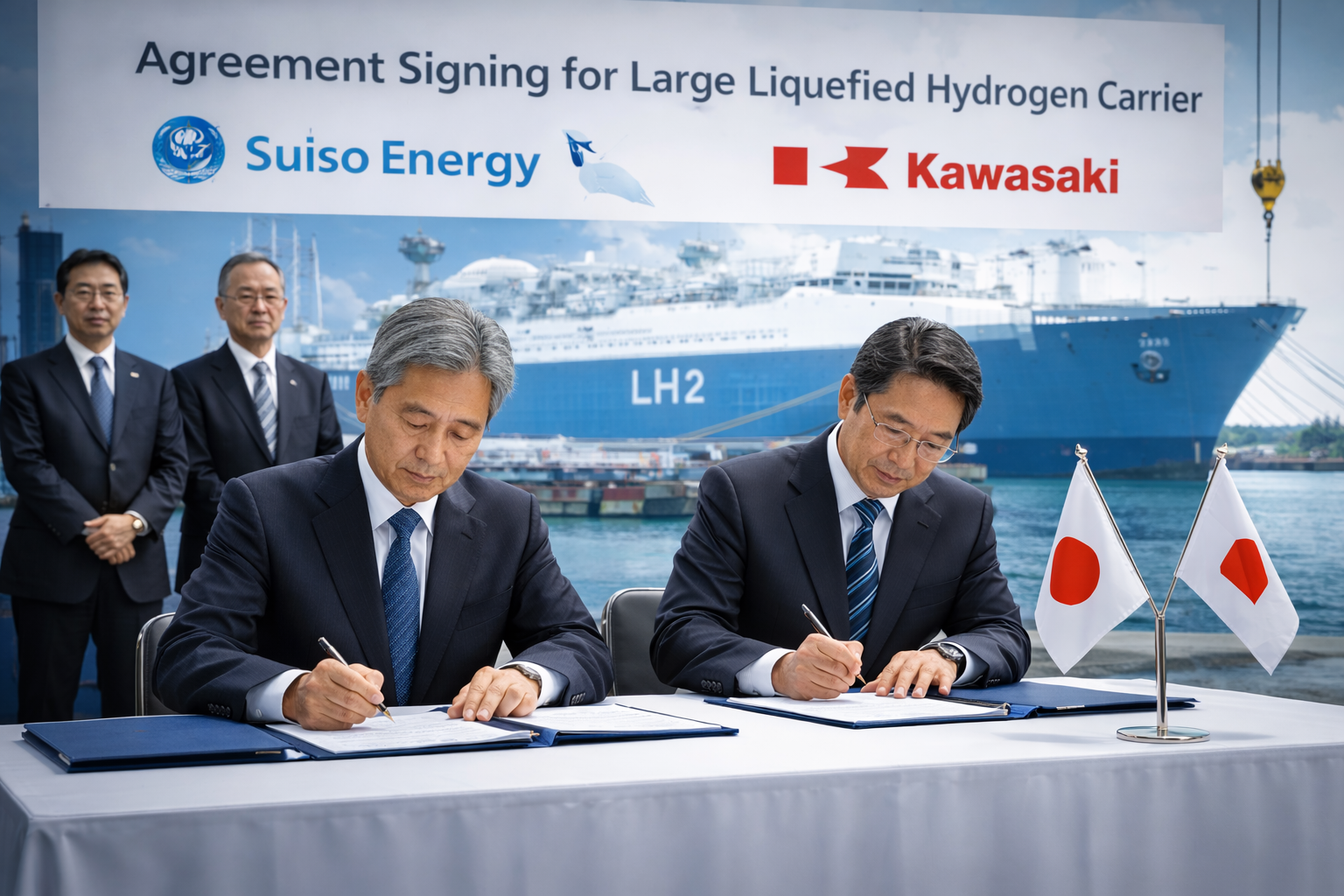
The Japanese government‑linked company Japan Suiso Energy and Kawasaki Heavy Industries have signed a contract to build a 40,000 cubic metre liquefied hydrogen carrier, a milestone in efforts to commercialise a hydrogen supply chain. The agreement was announced on January 6, 2026 and marks a step toward scaling maritime transport of liquid hydrogen at industrial volumes.
The new carrier will be constructed at Kawasaki’s Sakaide Works in Kagawa Prefecture, Japan, and is designed to transport liquefied hydrogen under a project backed by the New Energy and Industrial Technology Development Organization Green Innovation Fund. The initiative aims to demonstrate ship‑to‑shore loading and unloading of liquid hydrogen and to conduct sea trials under real ocean conditions.
Liquid hydrogen must be cooled to extremely low temperatures to remain in liquid form, presenting engineering challenges in insulation, storage, and handling. The planned carrier’s 40,000 cubic metre capacity is substantially larger than existing demonstration vessels and reflects industry efforts to advance hydrogen as a low‑carbon energy vector.
The contract supports Japan’s broader hydrogen strategy, which includes scaling production, transport, and use of hydrogen to reduce reliance on fossil fuels and support energy transition goals. Japan Suiso Energy, a project operator under the Green Innovation Fund, is coordinating the carrier’s development with the goal of expanding commercial‑scale supply chain infrastructure for liquefied hydrogen.
Stakeholders have said that establishing larger carriers is critical to linking hydrogen production sites with demand centres, particularly for industrial users and energy markets seeking alternatives to traditional fuels. The project is expected to inform subsequent phases of hydrogen logistics development, including terminal infrastructure and regulatory frameworks.
The contract announcement did not specify a delivery timeline, but earlier phases of liquefied hydrogen transport demonstrations have shown progress in moving hydrogen between ports and production facilities. Japan’s maritime and energy industries view these efforts as essential to scaling hydrogen as part of future clean energy systems.