


For much of the past four decades, Asia’s role in the global economy was framed through exports. Factories served distant consumers. Capital flowed outward. Demand was assumed to sit elsewhere. That picture is now starting to look dated. Across the region, consumption within Asia is rising fast enough to support growth on its own terms. Trade, investment, and production are adjusting around that fact, even if the old language still lingers.
This shift is often described as “Asia for Asia.” The phrase sounds neat, but the reality behind it is uneven and still forming. What is clear is that a larger share of Asian output is now sold to Asian buyers. China, India, Southeast Asia, and parts of the Middle East are linked less by their relationship with Western markets and more by each other’s demand cycles. Supply chains that once pointed outward are bending inward.
Consumption growth is central to this change. Household spending across Asia has expanded in both scale and range. Rising incomes have broadened demand beyond basic goods into services, healthcare, education, travel, and financial products. Urbanisation continues, but so does spending in smaller cities and regional centres. The customer base is not just larger. It is also more varied.
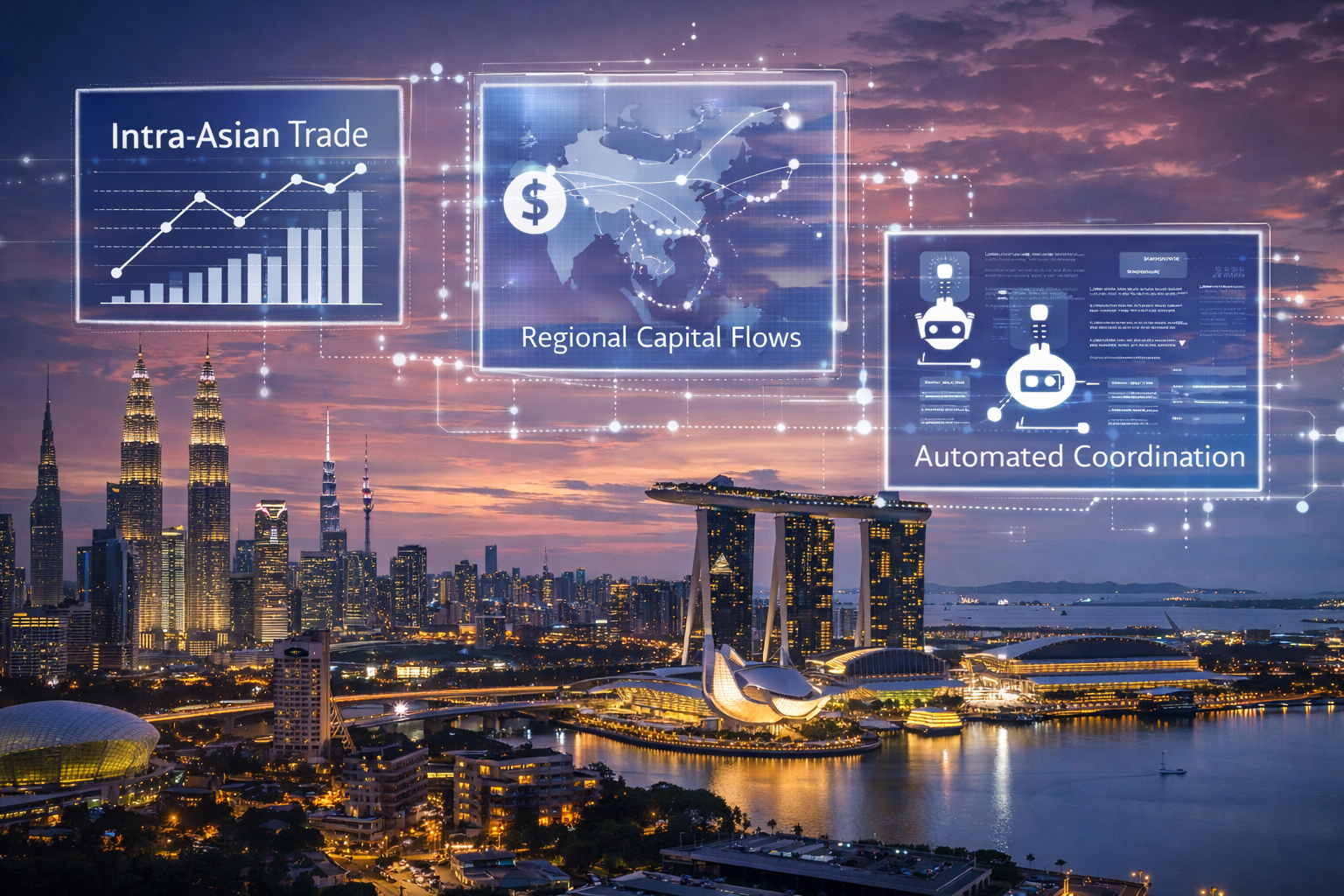
Trade data shows this clearly. Intra Asian trade has grown faster than Asia’s trade with Europe or North America for several years. This is not simply a rerouting of the same goods. It reflects deeper regional specialisation. Components, services, and digital products circulate within Asia before reaching a final user who is often also in Asia. The region is building a more complete economic loop.
Capital flows are adjusting alongside trade. Asian investors are putting more money into Asian assets. Regional stock markets, private credit, and infrastructure projects are increasingly funded from within the region. Sovereign funds, insurers, and pension pools are playing a larger role. This reduces reliance on external financing and changes how risk is priced. It also means that local policy decisions carry more weight locally than they once did.
Technology is part of this story, though not in the loud way often suggested. A new layer of automated decision software is spreading through logistics, finance, retail, and manufacturing. These systems handle planning, pricing, inventory, and customer interaction with limited human input. Their value lies less in novelty than in coordination. They allow complex regional networks to function with fewer delays and lower friction.
This matters because Asia’s growth is no longer concentrated in a single market. Demand is distributed across many countries with different regulations, currencies, and consumer habits. Managing that complexity at scale requires tools that can adapt quickly and operate continuously. Firms that serve Asian consumers are investing heavily in this infrastructure, often before similar investments appear elsewhere.
The result is a quieter shift in where economic gravity sits. Pricing power, product design, and even cultural cues are increasingly shaped by Asian preferences rather than Western ones. This is visible in consumer electronics, entertainment, tourism, and financial services. Products are launched regionally first. Global expansion, if it happens, comes later.
There is also a demographic dimension. Asia’s working age population is still large, though ageing is beginning to weigh on some economies. At the same time, younger consumers are more digitally fluent and more willing to adopt new services quickly. That combination supports rapid scaling within the region, even when per capita income levels differ widely.
None of this implies a clean break from the rest of the world. Asia remains deeply connected to global markets, and export demand still matters. But the balance has shifted. External shocks now interact with a stronger internal base. When growth slows in one part of the region, another often picks up the slack. This cushions volatility in a way that was not possible when demand was concentrated elsewhere.
There are tensions here. Regional integration brings competition as well as opportunity. Smaller economies worry about being overshadowed. Policy coordination remains uneven. And domestic inequality could limit consumption growth if it widens too far. These issues are not resolved. They are simply part of the landscape taking shape.
What feels different is the sense of permanence. This is not a temporary rebalancing driven by a single cycle or crisis. It reflects long term investment in infrastructure, institutions, and systems that support internal demand. Once built, these structures are hard to unwind. They change expectations quietly.
From the outside, the shift can be easy to miss. Global headlines still focus on exports, trade disputes, and capital flows to the West. But inside boardrooms and ministries across Asia, planning assumptions have changed. Growth strategies increasingly start at home or next door. That is a meaningful adjustment, even if it lacks a clear turning point.
Asia is not replacing one centre with another. It is building a centre of its own, defined by regional consumption and supported by software that manages complexity at scale. The process is gradual. It carries risks and contradictions. But it is already influencing how the global economy is organised, whether or not it is fully recognised.