

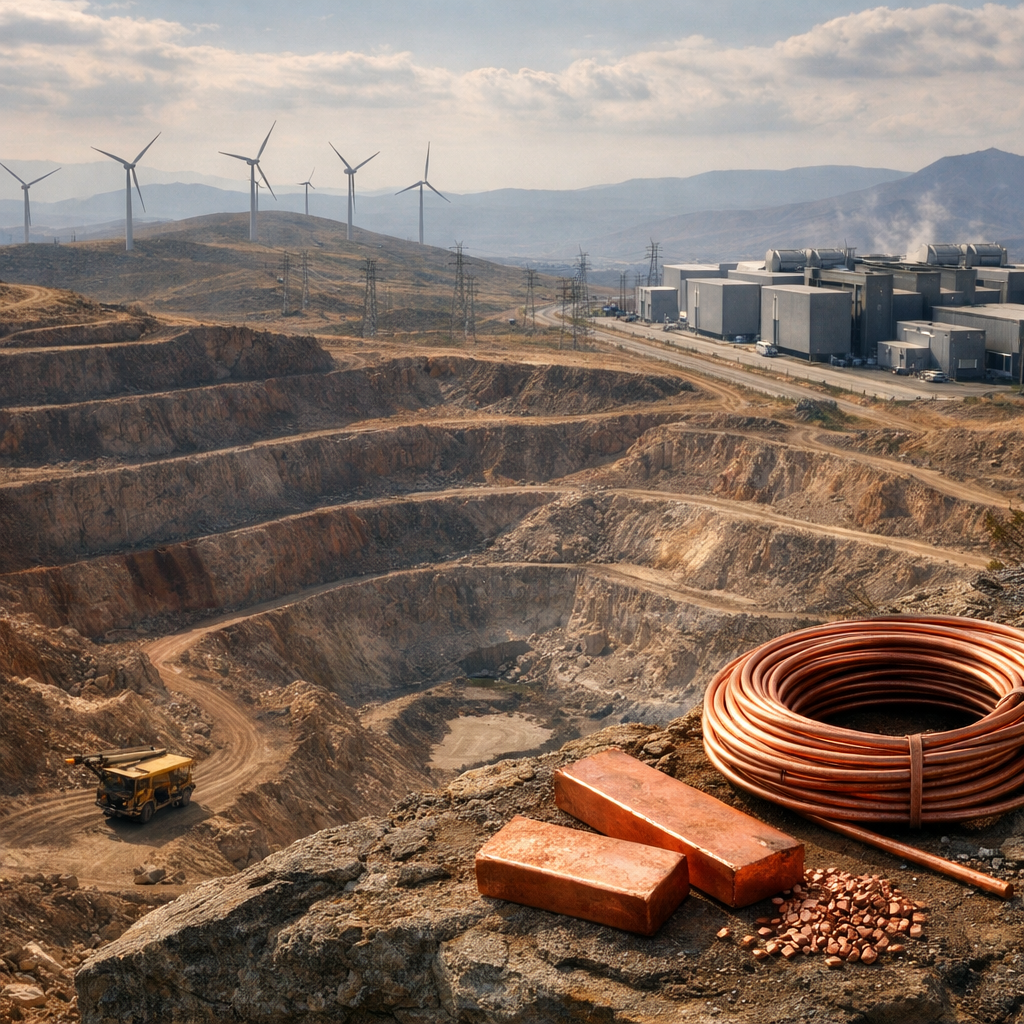
There is something quietly ironic about the material shaping the most advanced technologies of the century. While attention gravitates toward artificial intelligence models that seem almost immaterial, the real bottleneck of progress is heavy, red, and unmistakably physical. Copper, a metal known to humanity for thousands of years, is once again determining how far the future can move.
For decades, copper lived comfortably in the background of industrial life. It powered homes, connected cities, and disappeared behind walls and underground cables. Today, it has stepped into the foreground. Not because it has changed, but because everything around it has.
Artificial intelligence is not weightless. Data centers may feel abstract, but they are, at their core, massive electrical organisms. An AI-focused facility consumes several times more power than a traditional server farm, and every additional watt demands more copper. Cables thicken. Busbars multiply. Cooling systems expand. Scale, once measured in lines of code, is now measured in tonnes.
This pressure is arriving at the same moment as the electrification of transport and energy. Electric vehicles require far more copper than combustion engines. Wind farms stretch it across oceans. Solar installations weave it into grids that were never designed for such intensity. Each transition is logical on its own. Together, they collide.
What turns copper from a commodity into a strategic material is not scarcity in the absolute sense, but timing. Demand is global and simultaneous. Supply is slow, localized, and stubbornly resistant to acceleration. New mines do not respond to market enthusiasm. They respond to geology, permits, politics, and time. Fifteen years is a realistic horizon, and that assumes everything goes right.
Recycling, often presented as the graceful solution, struggles against a simple reality. Copper is not disappearing. It is being locked into systems meant to last decades. Power grids are extended, not replaced. Infrastructure is reinforced, not dismantled. The metal exists, but it is unavailable, frozen inside the skeleton of modern life.
This is where the conversation shifts from economics to consequence. Nations speak openly about technological independence, yet the foundation of that ambition rests beneath the surface of a few regions rich in ore. Securing access to copper is no longer a procurement challenge. It is a question of leverage, alignment, and long-term trust.
There is an uncomfortable mismatch between the speed of digital ambition and the pace of physical reality. Software evolves in months. Materials obey chemistry and gravity. We are asking an old supply chain to support a new kind of acceleration, and the strain is beginning to show.
None of this suggests collapse. It suggests constraint. Progress will continue, but not frictionlessly. Choices will matter more. Efficiency will stop being a slogan and become a necessity. The assumption that technology can scale independently of the material world is quietly dissolving.
Copper does not inspire awe. It does not glow or compute or speak. It conducts. It connects. It endures. In a century obsessed with intelligence, it is grounding us in something more fundamental: the fact that every future, no matter how digital, must still pass through matter.
And for now, that matter is copper.