

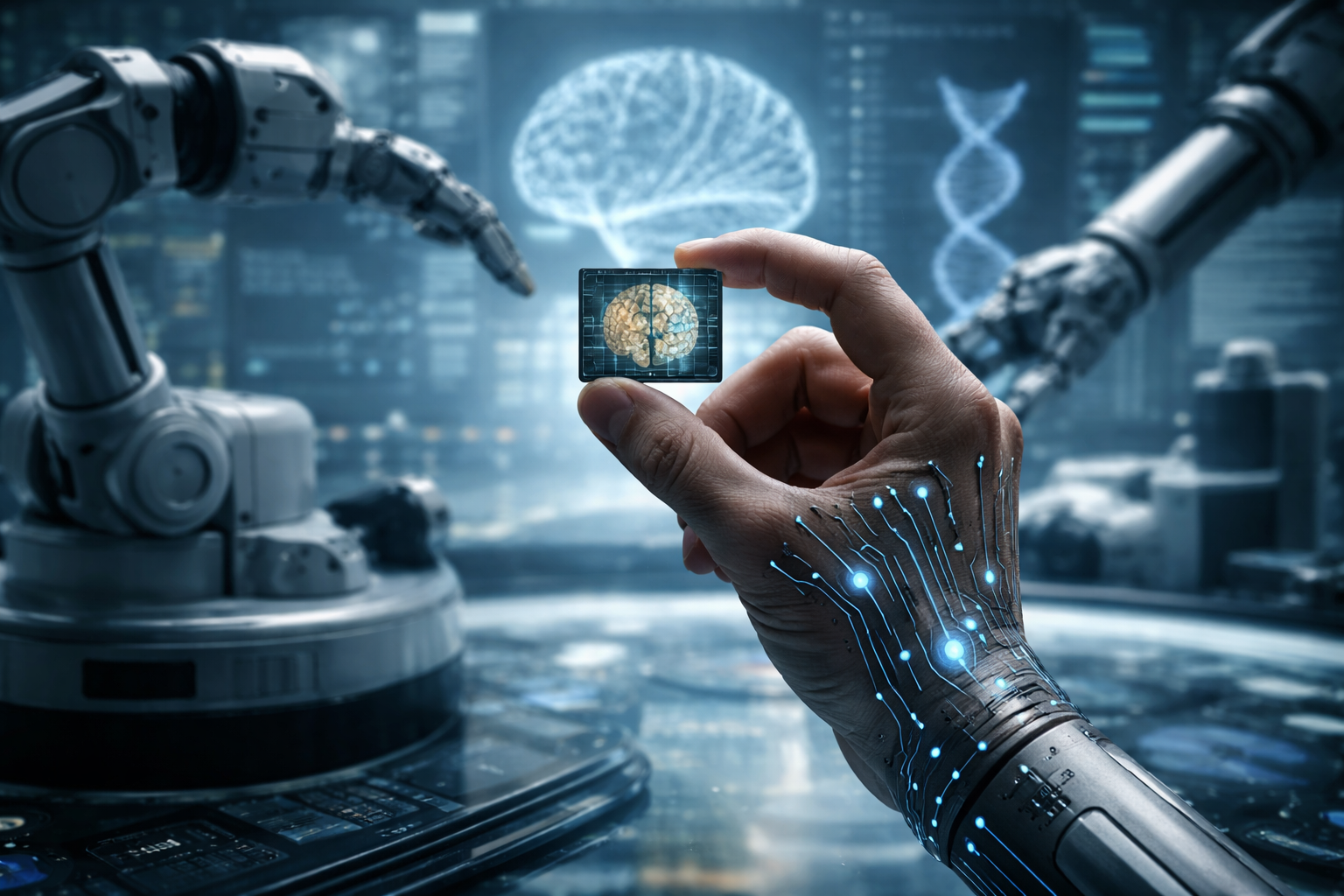
The idea that economic value rests primarily in the human body is starting to loosen. For centuries, labour, skill, and endurance were constrained by biology. Education improved output. Machines extended reach. But the worker remained a biological unit with fixed limits. That assumption is now under quiet pressure. The post biological economy does not discard the human. It reshapes what human capital means when cognition, health, and even presence can be modified, extended, or partly substituted.
This shift is not driven by ideology. It comes from incentives. Ageing populations are reducing the available workforce in many countries. Healthcare costs are rising faster than productivity. Firms are searching for output that is not tied so closely to hours worked or bodies present. At the same time, advances in biotechnology, neural interfaces, and artificial cognition are moving from research into application. None of this arrives as a single break. It accumulates.
Human capital has always been partly engineered. Nutrition, sanitation, schooling, and medicine were early forms of enhancement. What changes now is the depth and direction of intervention. Cognitive performance can be trained, measured, and supplemented with tools that operate in real time. Physical capacity can be supported or bypassed through robotics and remote systems. Longevity itself is becoming an economic variable rather than a demographic fate.
This raises a quiet but difficult question. If productivity is no longer tied to biological limits, who captures the gains. Historically, when labour became more efficient, wages eventually followed. But that link depended on scarcity. When output can be generated by augmented workers, or by systems that borrow only fragments of human input, bargaining power shifts. The post biological economy may reward those who control enhancement systems more than those who inhabit them.
Capital markets are already adjusting. Investment flows favour platforms that combine data, cognition, and automation. The valuation of firms rests less on headcount and more on intellectual property and system design. Labour becomes modular. A person may contribute judgment, supervision, or creativity, while execution is distributed across machines and software. This can raise output without raising employment in the usual sense.
There is also a fiscal dimension. Tax systems rely on income tied to work. Social insurance assumes predictable life cycles of education, employment, and retirement. If working lives extend unevenly, or if productivity decouples from hours worked, these frameworks strain. Some families are already encountering this in small ways. A parent working longer with cognitive assistance. A younger worker displaced not by automation alone, but by enhanced senior colleagues who do not exit when expected.
The language around this transition often drifts toward promise or fear. Both miss the texture of what is happening. The post biological economy is not a leap into science fiction. It is a series of adjustments that accumulate in workplaces, clinics, and balance sheets. Each step appears manageable. Together they alter how value is assigned to human contribution.
Education systems face an awkward recalibration. If skills can be updated continuously through augmentation, the role of early life schooling changes. Credentials may matter less than access to enhancement networks. Inequality could widen along new lines. Not between educated and uneducated, but between those whose biology is supported and extended and those whose is not.
There is no clear endpoint. Some enhancements will prove costly, fragile, or socially resisted. Others will normalise quickly. Regulation will lag, then intervene unevenly. Markets will test boundaries faster than institutions can respond. This has been the pattern before.
What distinguishes this phase is the erosion of a boundary that once anchored economic thought. The human body was a given. Growth worked around it. Now it is part of the variable set. That does not mean humanity disappears from economics. It means economics becomes more explicit about how humanity is shaped, priced, and supported.
For policymakers and investors, the task is not to forecast a single outcome. It is to recognise that human capital is no longer a stable category. It is becoming a field of design choices. Some will raise shared prosperity. Others will concentrate advantage. The consequences will unfold slowly, and unevenly, but they will be difficult to reverse once embedded.