

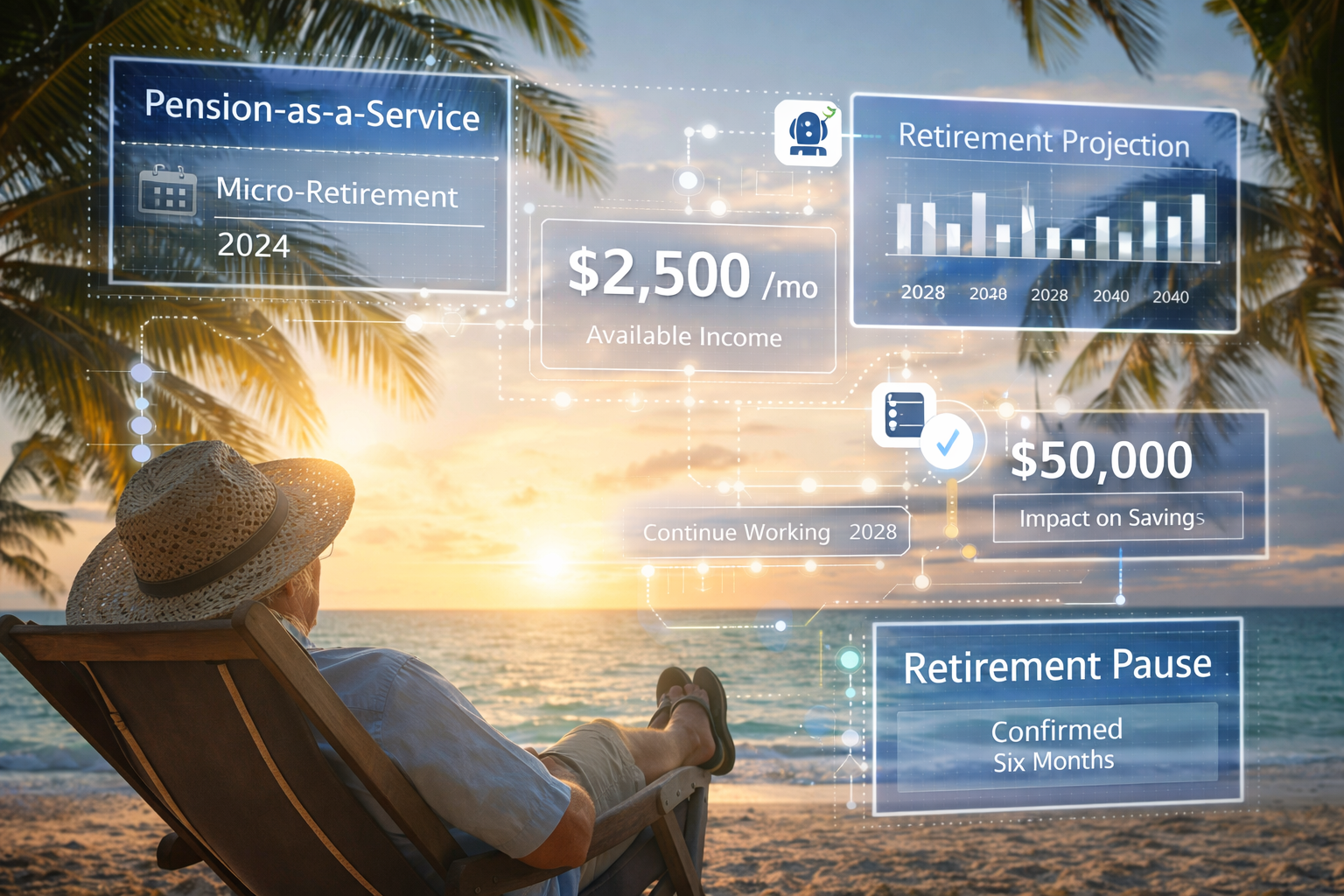
A shift is forming at the edges of the retirement industry. It is not about later exits from work, but earlier pauses within it. Across wealth management, employment benefits, and financial technology, a model often described as Pension-as-a-Service is beginning to support short, planned withdrawals from full-time work that sit well before traditional retirement age. These periods are increasingly referred to as micro-retirements.
Pension-as-a-Service describes the unbundling of pension infrastructure into modular financial components. Instead of a single long-term product tied to an employer or a state system, pension functions are being separated into contribution engines, tax wrappers, withdrawal logic, and compliance layers that can be recombined. This architecture was originally built to serve freelance and mobile workers whose careers no longer fit stable employment patterns. It is now being applied in ways that allow people to draw limited income earlier without fully exiting the labour market.
What is changing is not the idea of taking time off work, which is not new, but the financial machinery around it. New pension platforms increasingly calculate how much income can be safely drawn for short periods without collapsing long-term retirement projections. These calculations adjust continuously as earnings, markets, and employment status shift. The result is a form of controlled liquidity inside assets that were once treated as untouchable until a fixed age.
Several signals point to this change becoming more visible. Employers in technology, professional services, and creative industries are beginning to offer pension-linked sabbatical benefits. These are not framed as career breaks but as structured intervals funded partly through future retirement contributions. At the same time, regulators in parts of Europe, Australia, and Asia have opened narrow pathways for early, conditional pension access tied to health, reskilling, or caregiving, provided long-term adequacy tests are met.
Financial firms are also adjusting how they present retirement. Dashboards that once focused on a single end-date now show multiple potential drawdown points across a working life. Instead of asking when someone can stop working entirely, they ask when someone could step away for six months, a year, or two, and then return. This reframing has been subtle, but it changes how retirement savings are perceived. They start to look less like a sealed vault and more like a managed reserve.
The rise of micro-retirements is also connected to labour market patterns that reward episodic intensity. Many high-skill roles now run in cycles of heavy demand followed by quieter periods. Workers who move between contracts or projects are seeking financial structures that match this rhythm. Pension-as-a-Service platforms, by separating accumulation from a single employer, make this technically easier.
This does not mean that traditional retirement is disappearing. Most systems remain designed around long-term income security in old age, and the amounts accessible for early use are often limited. What is changing is the acknowledgement that careers no longer follow a straight line. Financial infrastructure is starting to reflect that reality, even if cautiously.
There are tensions embedded in this shift. Early access raises concerns about depletion and inequality, particularly for lower earners whose buffers are thinner. Regulators remain wary, and many schemes restrict micro-retirements to those who meet contribution thresholds or pass stress tests. These constraints are part of why the trend remains quiet rather than headline-grabbing.
Still, the pattern is becoming clearer. Retirement savings are being repositioned as a lifetime resource rather than a single end-state payout. Pension-as-a-Service provides the plumbing for that change. Micro-retirements are the visible behaviour that results. Together, they point to a reworking of how time, work, and deferred income relate to one another, not in theory, but in the everyday tools now appearing in financial products.