

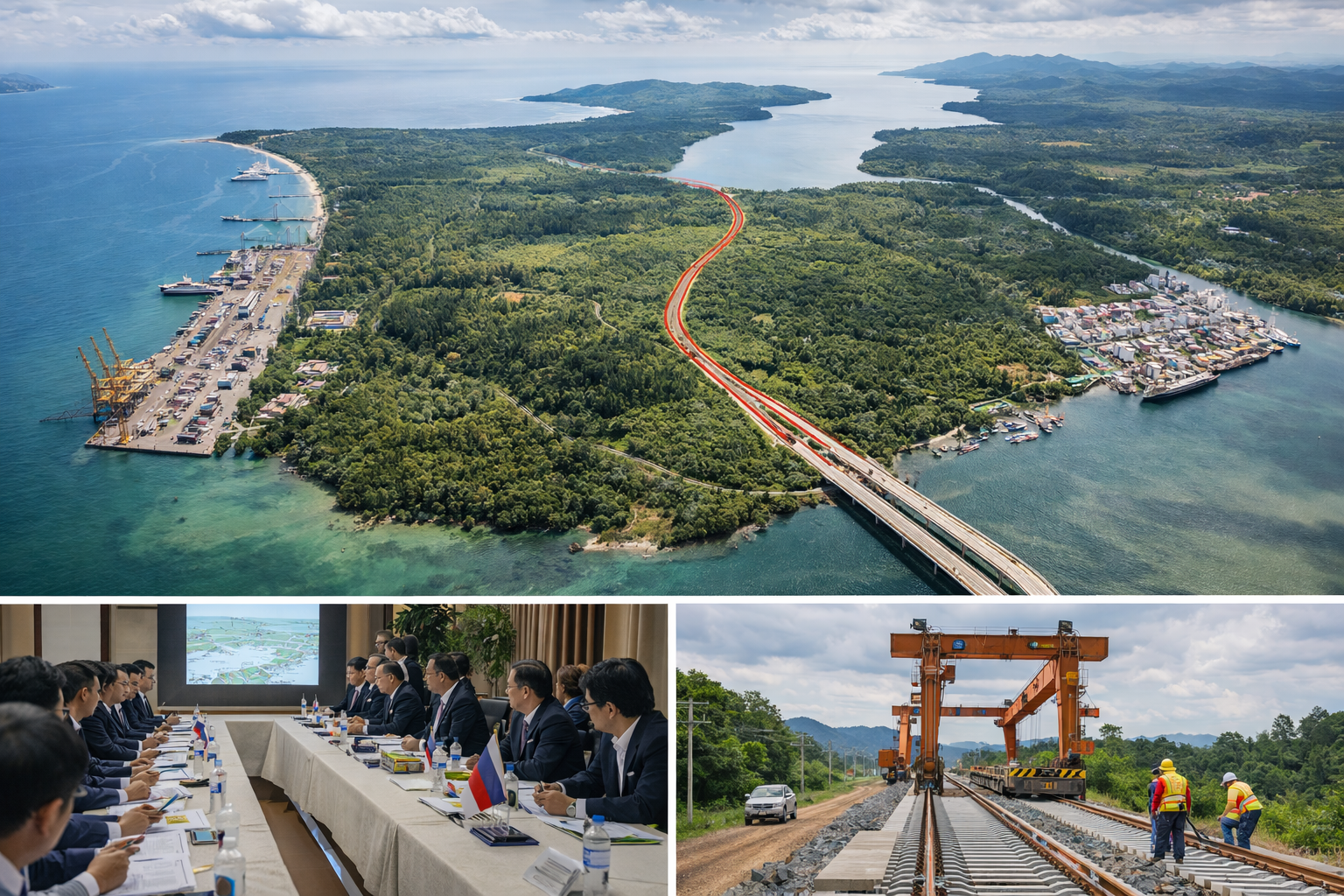
Thailand’s government has moved forward in 2026 with plans to develop a land bridge connecting the Gulf of Thailand and the Andaman Sea, presenting the project as an alternative trade route to the Strait of Malacca.
Officials confirmed that feasibility studies and initial environmental assessments are under review, with the project designed to link deep-sea ports on both coasts through rail and highway infrastructure across southern Thailand. The proposed corridor would allow cargo to be unloaded on one side of the peninsula, transported overland, and reloaded onto vessels on the opposite coast.
The Strait of Malacca, which runs between Malaysia, Singapore and Indonesia, remains one of the world’s busiest maritime routes. A significant share of global trade, including oil shipments to East Asia, passes through the narrow waterway each year. Periodic congestion and long-standing security concerns have prompted regional discussions about alternative routes.
Thailand’s transport ministry stated that the land bridge project aims to reduce transit time for selected cargo shipments by bypassing the need to sail through the Malacca Strait. Preliminary government documents indicate that the corridor would include two deep-water ports, logistics hubs and dual-track rail lines spanning roughly 90 kilometers across the Isthmus of Kra region.
Prime Ministerial representatives said the government is seeking foreign investment and public-private partnerships to fund construction. Delegations have held meetings with investors from China, Japan and Middle Eastern countries to present project details. Thai officials have described the initiative as a long-term infrastructure strategy intended to position the country as a regional logistics hub.
Neighbouring governments have not formally opposed the proposal. Malaysian authorities said they are monitoring developments, while Singapore’s maritime agencies noted that shipping volumes through the Malacca Strait remain stable.
Environmental groups within Thailand have called for transparent impact assessments, particularly regarding coastal ecosystems and local communities along the proposed corridor. The government has stated that consultations are ongoing and that final approval will depend on regulatory procedures.
Regional analysts note that alternative routes to the Malacca Strait have been discussed for decades, including canal proposals that were not implemented. The current land bridge plan differs in that it avoids cutting a canal and instead relies on overland transport between two ports.
Global shipping companies have not announced binding commitments to use the route. Industry representatives said decisions would depend on cost structures, port efficiency and reliability once the infrastructure is operational.
Construction timelines have not been finalised. Thai authorities indicated that further technical reviews and investment agreements are required before groundbreaking can begin.