

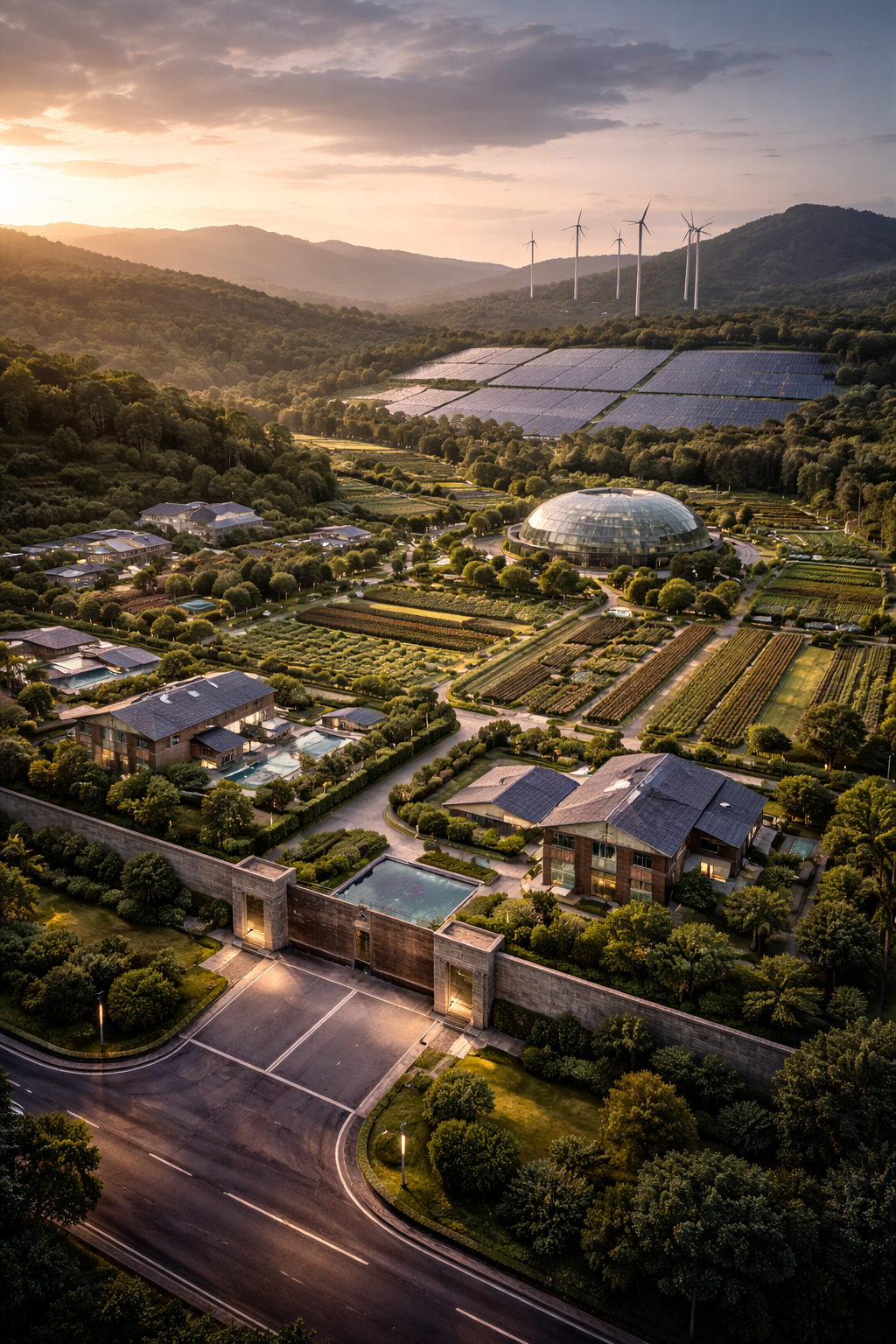
In earlier cycles of luxury development, excess was measured through scale, visibility, and access. Large residences, extensive travel, and global supply chains signalled status through openness. A different configuration is now emerging at the upper end of residential and lifestyle markets. Closed loop estates, designed to operate with minimal reliance on external systems, are becoming a distinct institutional form rather than an architectural curiosity.
These estates integrate energy generation, water management, food production, waste processing, and security within a single property or compound. Their defining feature is not size but closure. Inputs are reduced, dependencies are limited, and continuity is prioritised. What once appeared in remote eco-retreats or experimental communities is now visible in developments marketed to high-net-worth buyers and long-term residents seeking insulation from systemic volatility.
The conditions supporting this shift are observable. Public infrastructure in many advanced economies is under strain from ageing assets, fiscal pressure, and uneven maintenance. Utilities remain functional, but their reliability is increasingly variable across regions. At the same time, regulatory regimes governing energy, water, and land use have become more complex, raising uncertainty around future access and pricing. Closed loop estates respond to this environment by internalising functions that were previously assumed to be collective.
The financial logic is explicit. Developers frame self-sufficiency as asset protection rather than idealism. On-site generation and storage reduce exposure to grid instability and price fluctuation. Private water systems mitigate drought restrictions and service interruptions. Food production, even at a limited scale, provides redundancy rather than abundance. Each subsystem is justified less by cost savings than by continuity under stress.
This orientation reflects a broader redefinition of sustainability within luxury contexts. Earlier narratives emphasised reduced impact and shared responsibility. The emerging model focuses on endurance and control. Sustainability is interpreted as the ability to maintain standards regardless of external conditions. The ethical dimension shifts accordingly, from collective benefit to internal coherence.
Governance structures within these estates reinforce this logic. Rules governing resource use, maintenance, and access are contractually enforced through homeowner associations or private management entities. Decision-making is centralised, participation is limited to stakeholders, and compliance is monitored through technology. These arrangements resemble corporate governance more than municipal administration, with clear lines of authority and predefined service levels.
The appeal of this structure is not limited to environmental considerations. Security, data connectivity, and health services are often incorporated into the closed loop model. Private clinics, controlled access points, and redundant communication systems are marketed as integral features rather than optional add-ons. The estate becomes a platform capable of sustaining daily life with limited external interaction.
Geographically, these developments appear in both rural and peri-urban settings. In rural areas, they take the form of large properties retrofitted with advanced infrastructure. Near cities, they emerge as gated compounds positioned close enough to urban labour and cultural markets while remaining operationally distinct. In both cases, proximity is balanced against separation.
The ethical framing surrounding radical autarky remains understated but consequential. Advocates rarely present these estates as solutions to systemic challenges. Instead, they emphasise personal responsibility and preparedness. The language avoids overt critique of public systems, yet the design choices imply a lack of confidence in their long-term sufficiency.
This quiet repositioning matters because it alters expectations around provision and obligation. When essential services are internalised at the household or community level, the boundary between private and public responsibility shifts. The estate is no longer merely a place of residence but a micro-institution, assuming roles traditionally associated with the state or municipality.
Such developments also influence regulatory behaviour. Authorities often accommodate closed loop estates through exemptions, expedited permits, or flexible zoning, recognising their reduced demand on public resources. These accommodations, while pragmatic, further entrench the model by lowering barriers to replication.
The rise of closed loop estates does not signal a widespread withdrawal from shared systems. Their scale remains limited, and their costs are prohibitive for most. Their significance lies instead in what they reveal about changing priorities among those with the means to choose alternatives. Autarky, once associated with marginality or ideological commitment, is being normalised as a premium attribute.
This normalisation occurs without explicit advocacy. Marketing materials focus on resilience, design, and comfort rather than ethics. Yet the cumulative effect is a reconfiguration of luxury around separation rather than integration. The estate becomes a self-contained environment, calibrated to reduce exposure rather than maximise connection.
As these models proliferate, they introduce a new reference point for what high-standard living entails. Reliability replaces abundance, predictability replaces flexibility. The closed loop estate stands as a response to an environment perceived as less stable, even if that perception remains implicit.
The emergence of radical autarky in luxury settings thus reflects more than architectural innovation. It signals an institutional adjustment to constraint, expressed through private ordering rather than public reform. The ethics embedded in these spaces are not articulated as doctrine, but they are built into walls, systems, and contracts. Their presence suggests a recalibration of how responsibility, risk, and resilience are distributed across society.