

Close Menu
Briefory
    What's Hot

    The Sovereignty of the Self in an Age of Algorithmic Governance

    13.02.2026

    The Chronos Strategy and the Death of the Always-On Executive Culture

    13.02.2026

    Direct Indexing and the Democratization of Tax-Loss Harvesting for High-Net-Worth Portfolios

    13.02.2026
    Facebook X (Twitter) Instagram
    Trending
    • The Sovereignty of the Self in an Age of Algorithmic Governance
    • The Chronos Strategy and the Death of the Always-On Executive Culture
    • Direct Indexing and the Democratization of Tax-Loss Harvesting for High-Net-Worth Portfolios
    • The Fragmentation Gamble and the Rise of Issue-Based Partnerships in the Global South
    • The Polycentric Shift and Why American Transactionalism is Redefining Global Power Dynamics in 2026
    • The Neuro-Symbolic Pivot and Why Pure Neural Networks are Reaching a Reasoning Ceiling
    • Trans-Arctic Cable Initiative Gains Momentum Amid Strategic Rivalry
    • Beyond Silicon and the Commercial Viability of Diamond-Based Power Electronics
    Facebook X (Twitter) Instagram
    BrieforyBriefory
    Sunday, April 19
    • World
      • Americas
      • Europe
      • Asia-Pacific
      • Africa
      • Middle East
    • Economy & Business
      • Global Economy
      • Real Estate
      • Startups
    • Finance & Markets
      • Stock Market
      • Crypto & Web3
      • Commodities
      • Forex
    • Health & Biohacking
      • Longevity
      • Mental Wellness
      • Medical Breakthroughs
    • Lifestyle & Luxury
      • High-End Travel
      • Sustainable Living
      • Work-Life Balance
    • Personal Finance
      • Global Tax & Equity
      • Retirement Planning
      • Wealth Management
    • Perspectives
      • Expert Briefings
      • Future Trends
      • Global Opinions
    • Tech & AI
      • Artificial Intelligence
      • Cyber Security
      • Future Tech
    • The Brief
      • Daily Briefings
      • Tech Radar
      • Deep Dives
    Briefory
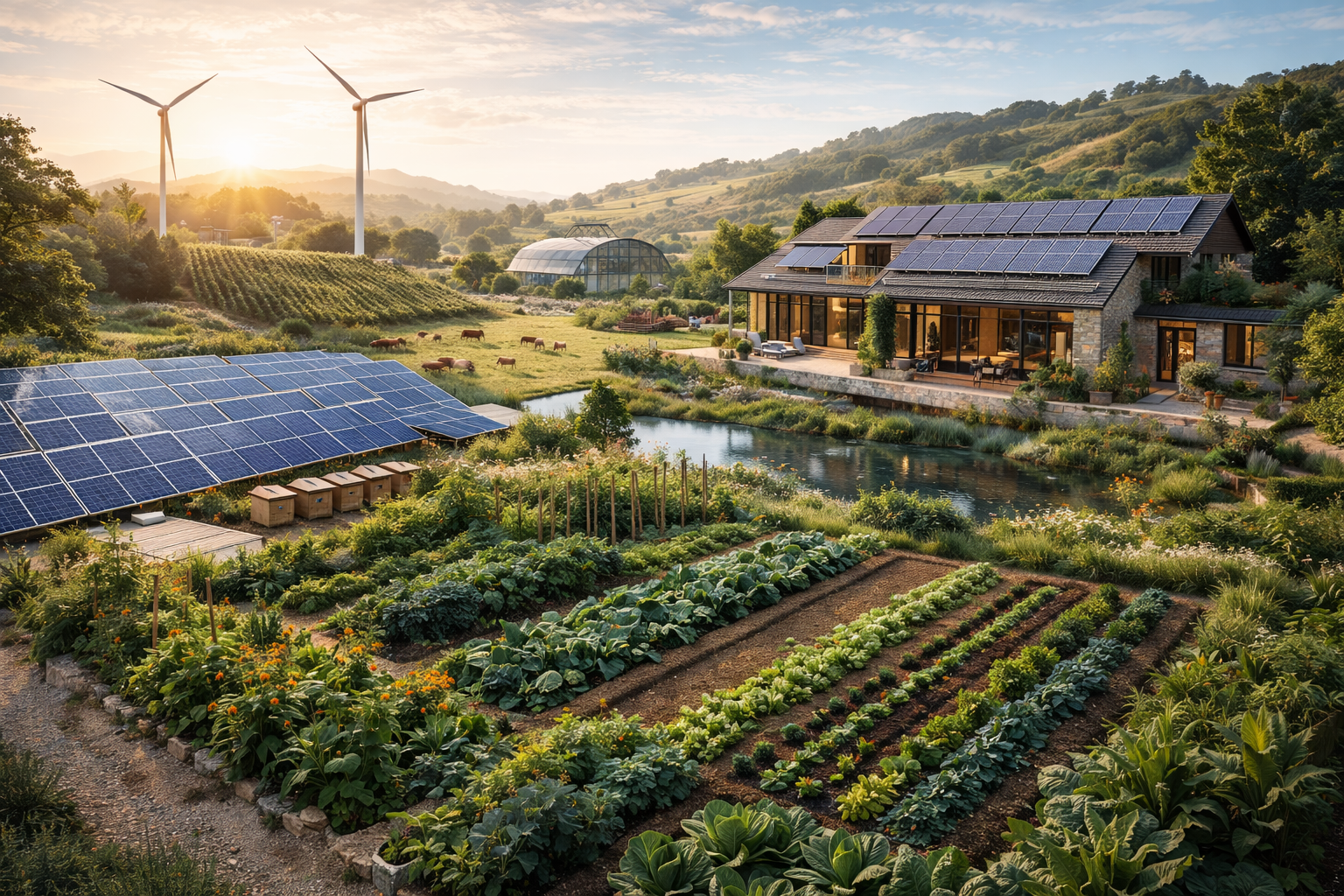
    Editorial photograph of a modern countryside estate with solar panels, cultivated gardens, water reservoirs, and restored natural landscape, illustrating a self-sustaining luxury property designed around regenerative living.

    Beyond Plastic-Free: The Rise of Regenerative Estates and Self-Sustaining Luxury Ecosystems

    0
    By Briefory Insights on 12.02.2026 Sustainable Living, Lifestyle & Luxury
    Share
    Facebook Twitter LinkedIn Copy Link

    For years, sustainable luxury was defined by subtraction. Plastic-free amenities. Organic linens. Locally sourced ingredients. The emphasis was on reducing harm without altering the broader structure of consumption. That framework is beginning to shift.

    A different model is emerging at the upper end of the property market. Instead of simply minimising environmental impact, a small but growing number of high-value estates are being designed to generate their own energy, manage water independently, produce food on site, and restore surrounding land. The objective is not only lower footprint. It is partial autonomy.

    Large rural compounds, coastal retreats, and mountain residences are incorporating regenerative agriculture, closed-loop water systems, solar arrays, battery storage, and soil restoration programmes. In some cases, properties operate as micro-ecosystems. Waste is composted. Greywater is reused. Landscapes are planned to increase biodiversity rather than reduce visibility.

    The shift is visible in architectural briefs. Developers are engaging ecologists alongside designers. Permaculture principles are appearing in master plans once dominated by aesthetic considerations. Estate managers are being hired with backgrounds in environmental science rather than hospitality alone.

    This is not a mass-market movement. It remains concentrated among ultra-high-net-worth buyers with access to land and long planning horizons. Yet it reflects a recalibration of what luxury signifies. Self-sufficiency, once associated with remoteness, is being reframed as resilience.

    Climate volatility is one driver. Wildfires, droughts, and grid instability have altered how wealthy property owners assess risk. Backup generators are being replaced by integrated renewable systems. Private water rights are being supplemented with on-site treatment facilities. The estate becomes a buffer.

    Food production is also part of the equation. Vineyards, orchards, and kitchen gardens are expanding from ornamental features into operational components. Dedicated agronomists manage soil regeneration. Livestock, where permitted, are integrated into land cycles. The visual language of wealth is becoming greener, but the underlying logic is practical.

    Hospitality is adapting in parallel. High-end resorts are marketing rewilding programmes and regenerative farming partnerships. Guests are offered not only comfort but participation in land restoration. The experience blends privacy with stewardship.

    There is a subtle shift in status signalling here. Visible restraint is no longer the sole marker of ethical awareness. Control over resources and systems is gaining weight. Owning land that restores itself, rather than depletes, carries quiet prestige.

    Financial structures are adjusting as well. Some family offices are integrating land management into broader portfolio strategies. Carbon credits, biodiversity offsets, and ecosystem services are being evaluated not as speculative assets, but as extensions of estate operations. The property is both residence and environmental project.

    Technology plays a supporting role. Smart grids within estates manage energy flow. Sensors monitor soil health and water use. Automation is embedded, but discreet. The aesthetic remains natural, even if the infrastructure beneath it is highly engineered.

    What differentiates this moment from earlier green branding cycles is the scale of integration. Sustainability features are not appended. They are foundational. The estate is conceived as a living system with inputs and outputs that can be measured and adjusted.

    This does not suggest a universal shift in luxury real estate. Urban penthouses and traditional trophy properties continue to command attention. But at the margins of the market, a different template is forming. It privileges durability over display.

    The language around these properties reflects that evolution. Words such as regenerative, closed-loop, and ecosystem are appearing in sales materials that once emphasised marble finishes and panoramic views. The asset is no longer only the structure. It is the land’s capacity to sustain itself.

    What is visible now is an early convergence between environmental management and private wealth. Estates are being designed not only as retreats from instability, but as contained systems capable of absorbing it.

    Luxury, in this context, is shifting from consumption to cultivation.

    Keep Reading

    The Chronos Strategy and the Death of the Always-On Executive Culture

    The Silent Voyage and Why Ultra-Private Orbital Tourism is the Final Frontier of Luxury

    The “Soft Life” Economy: Why High-Net-Worth Individuals are Prioritizing Time-Arbitrage over Status Symbols

    The Dawn of Orbital Hospitality and the Privatization of the Horizon

    The Rise of Closed Loop Estates and the New Ethics of Radical Autarky

    The Chronobiology Premium and the Pursuit of Asynchronous High Performance

    Leave A Reply Cancel Reply

    Latest Posts
    Advertisement
    Demo

    Recent Posts

    • The Sovereignty of the Self in an Age of Algorithmic Governance
    • The Chronos Strategy and the Death of the Always-On Executive Culture
    • Direct Indexing and the Democratization of Tax-Loss Harvesting for High-Net-Worth Portfolios
    • The Fragmentation Gamble and the Rise of Issue-Based Partnerships in the Global South
    • The Polycentric Shift and Why American Transactionalism is Redefining Global Power Dynamics in 2026
    Facebook X (Twitter) WhatsApp TikTok Instagram

    News

    • World News
    • Politics
    • Business
    • Technology

    Company

    • Privacy & Policy
    • Editorial Policy
    • Copyright & DMCA Policy
    • Terms of Use

    Contact

    • Contact
    • About Briefory

    Stay Informed. Stay Briefed.

    Essential global news, carefully selected and delivered by Briefory

    © 2026 Briefory.com Designed & Developed by lv8 – Consulting.
    • Privacy Policy
    • Terms
    • Copyright & DMCA Policy

    Type above and press Enter to search. Press Esc to cancel.

    Your privacy settings

    We and our partners use information collected through cookies and similar technologies to improve your experience on our site, analyse how you use it and for marketing purposes. Because we respect your right to privacy, you can choose not to allow some types of cookies. However, blocking some types of cookies may impact your experience of the site and the services we are able to offer. In some cases, data obtained from cookies is shared with third parties for analytics or marketing reasons. You can exercise your right to opt-out of that sharing at any time by disabling cookies.
    Privacy Policy

    Manage Consent Preferences

    Necessary

    Always ON
    These cookies and scripts are necessary for the website to function and cannot be switched off. They are usually only set in response to actions made by you which amount to a request for services, suchas setting your privacy preferences, logging in or filling in forms. You can set your browser to block oralert you about these cookies, but some parts of the site will not then work. These cookies do not store any personally identifiable information.

    Analytics

    These cookies and scripts allow us to count visits and traffic sources, so we can measure and improve the performance of our site. They help us know which pages are the most and least popular and see how visitors move around the site. All information these cookies collect is aggregated and therefore anonymous. If you do not allow these cookies and scripts, we will not know when you have visited our site.

    Embedded Videos

    These cookies and scripts may be set through our site by external video hosting services likeYouTube or Vimeo. They may be used to deliver video content on our website. It’s possible for the video provider to build a profile of your interests and show you relevant adverts on this or other websites. They do not store directly personal information, but are based on uniquely identifying your browser and internet device. If you do not allow these cookies or scripts it is possible that embedded video will not function as expected.

    Google Fonts

    Google Fonts is a font embedding service library. Google Fonts are stored on Google's CDN. The Google Fonts API is designed to limit the collection, storage, and use of end-user data to only what is needed to serve fonts efficiently. Use of Google Fonts API is unauthenticated. No cookies are sent by website visitors to the Google Fonts API. Requests to the Google Fonts API are made to resource-specific domains, such as fonts.googleapis.com or fonts.gstatic.com. This means your font requests are separate from and don't contain any credentials you send to google.com while using other Google services that are authenticated, such as Gmail.

    Marketing

    These cookies and scripts may be set through our site by our advertising partners. They may be used by those companies to build a profile of your interests and show you relevant adverts on other sites. They do not store directly personal information, but are based on uniquely identifying your browser and internet device. If you do not allow these cookies and scripts, you will experience less targeted advertising.
    Disable all Confirm my choices Allow all
    Verified by ConsentMagic
    My Consent Preferences