

Close Menu
Briefory
    What's Hot

    The Sovereignty of the Self in an Age of Algorithmic Governance

    13.02.2026

    The Chronos Strategy and the Death of the Always-On Executive Culture

    13.02.2026

    Direct Indexing and the Democratization of Tax-Loss Harvesting for High-Net-Worth Portfolios

    13.02.2026
    Facebook X (Twitter) Instagram
    Trending
    • The Sovereignty of the Self in an Age of Algorithmic Governance
    • The Chronos Strategy and the Death of the Always-On Executive Culture
    • Direct Indexing and the Democratization of Tax-Loss Harvesting for High-Net-Worth Portfolios
    • The Fragmentation Gamble and the Rise of Issue-Based Partnerships in the Global South
    • The Polycentric Shift and Why American Transactionalism is Redefining Global Power Dynamics in 2026
    • The Neuro-Symbolic Pivot and Why Pure Neural Networks are Reaching a Reasoning Ceiling
    • Trans-Arctic Cable Initiative Gains Momentum Amid Strategic Rivalry
    • Beyond Silicon and the Commercial Viability of Diamond-Based Power Electronics
    Facebook X (Twitter) Instagram
    BrieforyBriefory
    Sunday, April 19
    • World
      • Americas
      • Europe
      • Asia-Pacific
      • Africa
      • Middle East
    • Economy & Business
      • Global Economy
      • Real Estate
      • Startups
    • Finance & Markets
      • Stock Market
      • Crypto & Web3
      • Commodities
      • Forex
    • Health & Biohacking
      • Longevity
      • Mental Wellness
      • Medical Breakthroughs
    • Lifestyle & Luxury
      • High-End Travel
      • Sustainable Living
      • Work-Life Balance
    • Personal Finance
      • Global Tax & Equity
      • Retirement Planning
      • Wealth Management
    • Perspectives
      • Expert Briefings
      • Future Trends
      • Global Opinions
    • Tech & AI
      • Artificial Intelligence
      • Cyber Security
      • Future Tech
    • The Brief
      • Daily Briefings
      • Tech Radar
      • Deep Dives
    Briefory
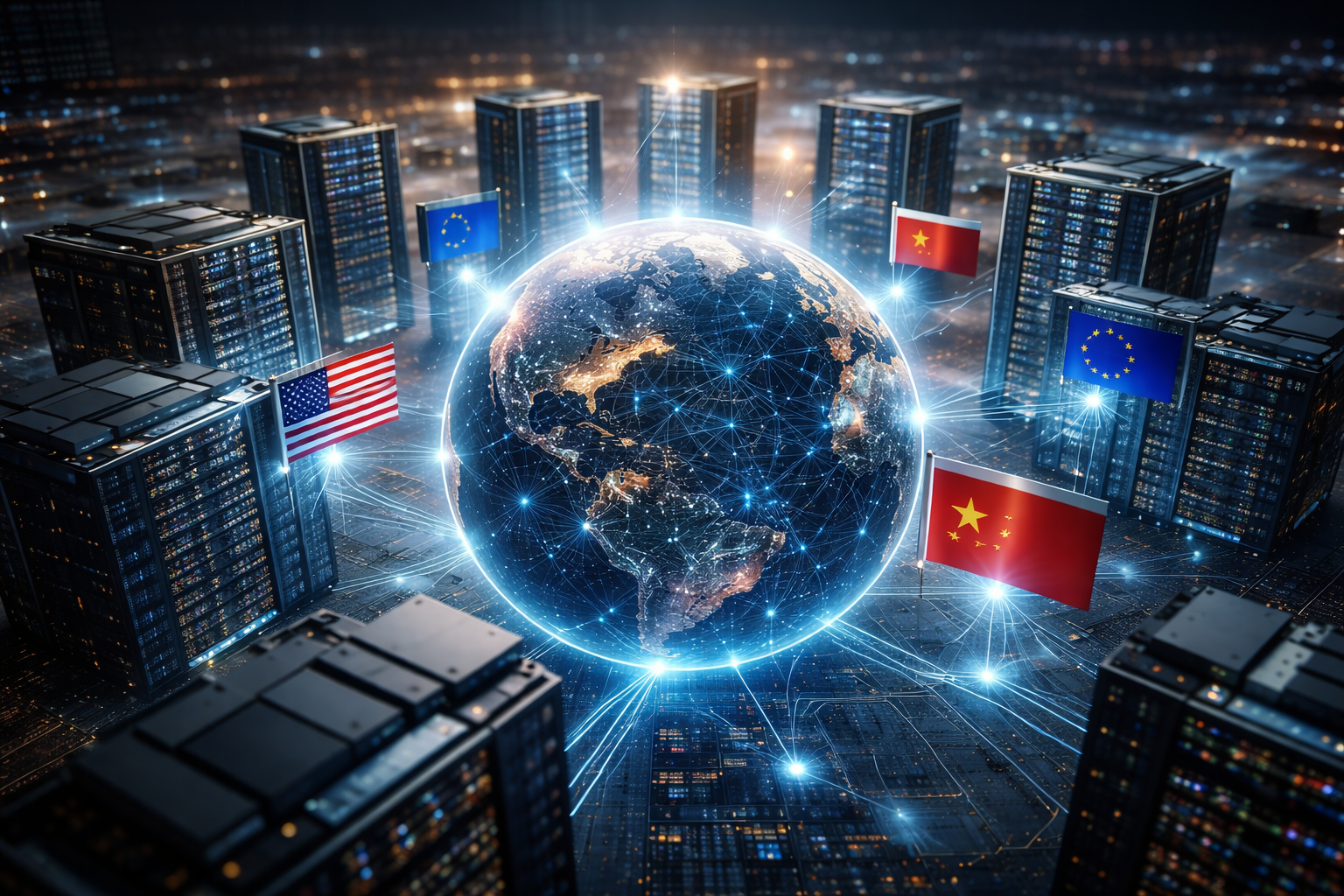
    Global data centers and national symbols surround a connected digital globe, representing geopolitical competition over AI compute and sovereign intelligence.

    The Geopolitics of Compute and the Race for Sovereign Intelligence

    0
    By Analysis on 11.02.2026 Deep Dives, The Brief
    Share
    Facebook Twitter LinkedIn Copy Link

    For most of the digital era, computing power was treated as a technical input. It was expensive, but largely neutral. Chips were manufactured where it made economic sense. Data flowed across borders with few questions asked. Intelligence, whether human or artificial, was assumed to be portable.

    That assumption is breaking down. Compute is becoming geopolitical. Not because it is scarce in absolute terms, but because it concentrates power in ways that states increasingly recognize as strategic. Access to advanced chips, large-scale data centers, and the energy that sustains them now shapes national capability as directly as oil or steel once did.

    Artificial intelligence accelerates this shift. Training frontier models requires enormous computational resources. These resources cannot be improvised. They depend on supply chains, manufacturing capacity, and stable infrastructure. Countries that control these layers gain leverage. Those that depend on others inherit vulnerability.

    The concept of sovereign intelligence emerges from this tension. It reflects a desire to ensure that critical AI systems can be developed, deployed, and governed within national or regional control. The concern is not only economic competitiveness. It is autonomy. Intelligence embedded in defense systems, public services, and economic planning cannot be fully outsourced without consequence.

    This race is uneven. A small number of countries dominate advanced semiconductor design and fabrication. An even smaller number control the tools required to manufacture the most advanced chips. Export controls, once a niche policy instrument, are now central to technology strategy. Compute has become a bargaining chip.

    The result is a fragmented landscape. Alliances form around shared access. Restrictions harden around perceived rivals. Global supply chains that once optimized for efficiency are reconfigured for security. Redundancy replaces elegance. Cost is accepted as the price of control.

    There is a contradiction at the center of this movement. Intelligence benefits from scale. Models improve with more data, more compute, and more interaction. Sovereignty pushes toward duplication and isolation. Each state wants its own stack, its own models, its own infrastructure. This tension slows progress even as it reshapes incentives.

    Private firms sit uneasily in the middle. The most advanced AI capabilities are developed by companies, not governments. Yet their dependencies are physical and local. Data centers draw on national grids. Chips cross borders. Regulation follows flags. Corporate strategy increasingly aligns with state interest, sometimes voluntarily, sometimes not.

    One uncomfortable observation is that sovereignty rhetoric often masks fear of dependence rather than confidence in capability. Building independent compute capacity is expensive and slow. Many countries will struggle to justify the investment without overstating the threat. This can lead to symbolic projects that signal ambition but deliver limited resilience.

    Still, the direction is clear. Compute is no longer just infrastructure. It is an instrument of power. Decisions about where models are trained, who controls inference at scale, and which systems are trusted become political by default. Neutrality becomes harder to maintain.

    This shift also affects smaller states. Lacking the resources to compete directly, they face choices about alignment. Joining a larger compute bloc offers access but reduces autonomy. Going alone preserves control but limits capability. There is no cost-free option.

    The race for sovereign intelligence will not produce clear winners in the short term. It will produce friction. Innovation slows in some areas and accelerates in others. Global collaboration becomes conditional. Technical decisions acquire diplomatic weight.

    Over time, the definition of sovereignty itself may shift. Control over borders mattered in the industrial age. Control over information mattered in the digital age. Control over intelligence, embodied in compute, may define the next phase. Not because states seek dominance, but because dependence has become too risky to ignore.

    The geopolitics of compute is not about machines replacing politics. It is about politics returning to the foundations of intelligence. As AI systems grow more central, the question is not who builds the best models, but who decides where intelligence lives, and under whose authority it operates.

    Keep Reading

    Trans-Arctic Cable Initiative Gains Momentum Amid Strategic Rivalry

    Beyond Silicon and the Commercial Viability of Diamond-Based Power Electronics

    The Great Semiconductor Reshoring and the Geometric Logic of the New Industrial Clusters

    Japan and Kawasaki Agree Contract for Large Liquefied Hydrogen Carrier

    The Post-Silicon Transition and the Commercialization of Graphene Semiconductors

    The Subsea Vulnerability and the Great Decoupling of the Global Internet

    Leave A Reply Cancel Reply

    Latest Posts
    Advertisement
    Demo

    Recent Posts

    • The Sovereignty of the Self in an Age of Algorithmic Governance
    • The Chronos Strategy and the Death of the Always-On Executive Culture
    • Direct Indexing and the Democratization of Tax-Loss Harvesting for High-Net-Worth Portfolios
    • The Fragmentation Gamble and the Rise of Issue-Based Partnerships in the Global South
    • The Polycentric Shift and Why American Transactionalism is Redefining Global Power Dynamics in 2026
    Facebook X (Twitter) WhatsApp TikTok Instagram

    News

    • World News
    • Politics
    • Business
    • Technology

    Company

    • Privacy & Policy
    • Editorial Policy
    • Copyright & DMCA Policy
    • Terms of Use

    Contact

    • Contact
    • About Briefory

    Stay Informed. Stay Briefed.

    Essential global news, carefully selected and delivered by Briefory

    © 2026 Briefory.com Designed & Developed by lv8 – Consulting.
    • Privacy Policy
    • Terms
    • Copyright & DMCA Policy

    Type above and press Enter to search. Press Esc to cancel.

    Your privacy settings

    We and our partners use information collected through cookies and similar technologies to improve your experience on our site, analyse how you use it and for marketing purposes. Because we respect your right to privacy, you can choose not to allow some types of cookies. However, blocking some types of cookies may impact your experience of the site and the services we are able to offer. In some cases, data obtained from cookies is shared with third parties for analytics or marketing reasons. You can exercise your right to opt-out of that sharing at any time by disabling cookies.
    Privacy Policy

    Manage Consent Preferences

    Necessary

    Always ON
    These cookies and scripts are necessary for the website to function and cannot be switched off. They are usually only set in response to actions made by you which amount to a request for services, suchas setting your privacy preferences, logging in or filling in forms. You can set your browser to block oralert you about these cookies, but some parts of the site will not then work. These cookies do not store any personally identifiable information.

    Analytics

    These cookies and scripts allow us to count visits and traffic sources, so we can measure and improve the performance of our site. They help us know which pages are the most and least popular and see how visitors move around the site. All information these cookies collect is aggregated and therefore anonymous. If you do not allow these cookies and scripts, we will not know when you have visited our site.

    Embedded Videos

    These cookies and scripts may be set through our site by external video hosting services likeYouTube or Vimeo. They may be used to deliver video content on our website. It’s possible for the video provider to build a profile of your interests and show you relevant adverts on this or other websites. They do not store directly personal information, but are based on uniquely identifying your browser and internet device. If you do not allow these cookies or scripts it is possible that embedded video will not function as expected.

    Google Fonts

    Google Fonts is a font embedding service library. Google Fonts are stored on Google's CDN. The Google Fonts API is designed to limit the collection, storage, and use of end-user data to only what is needed to serve fonts efficiently. Use of Google Fonts API is unauthenticated. No cookies are sent by website visitors to the Google Fonts API. Requests to the Google Fonts API are made to resource-specific domains, such as fonts.googleapis.com or fonts.gstatic.com. This means your font requests are separate from and don't contain any credentials you send to google.com while using other Google services that are authenticated, such as Gmail.

    Marketing

    These cookies and scripts may be set through our site by our advertising partners. They may be used by those companies to build a profile of your interests and show you relevant adverts on other sites. They do not store directly personal information, but are based on uniquely identifying your browser and internet device. If you do not allow these cookies and scripts, you will experience less targeted advertising.
    Disable all Confirm my choices Allow all
    Verified by ConsentMagic
    My Consent Preferences