


Close Menu
Briefory
    What's Hot

    The Sovereignty of the Self in an Age of Algorithmic Governance

    13.02.2026

    The Chronos Strategy and the Death of the Always-On Executive Culture

    13.02.2026

    Direct Indexing and the Democratization of Tax-Loss Harvesting for High-Net-Worth Portfolios

    13.02.2026
    Facebook X (Twitter) Instagram
    Trending
    • The Sovereignty of the Self in an Age of Algorithmic Governance
    • The Chronos Strategy and the Death of the Always-On Executive Culture
    • Direct Indexing and the Democratization of Tax-Loss Harvesting for High-Net-Worth Portfolios
    • The Fragmentation Gamble and the Rise of Issue-Based Partnerships in the Global South
    • The Polycentric Shift and Why American Transactionalism is Redefining Global Power Dynamics in 2026
    • The Neuro-Symbolic Pivot and Why Pure Neural Networks are Reaching a Reasoning Ceiling
    • Trans-Arctic Cable Initiative Gains Momentum Amid Strategic Rivalry
    • Beyond Silicon and the Commercial Viability of Diamond-Based Power Electronics
    Facebook X (Twitter) Instagram
    BrieforyBriefory
    Sunday, April 19
    • World
      • Americas
      • Europe
      • Asia-Pacific
      • Africa
      • Middle East
    • Economy & Business
      • Global Economy
      • Real Estate
      • Startups
    • Finance & Markets
      • Stock Market
      • Crypto & Web3
      • Commodities
      • Forex
    • Health & Biohacking
      • Longevity
      • Mental Wellness
      • Medical Breakthroughs
    • Lifestyle & Luxury
      • High-End Travel
      • Sustainable Living
      • Work-Life Balance
    • Personal Finance
      • Global Tax & Equity
      • Retirement Planning
      • Wealth Management
    • Perspectives
      • Expert Briefings
      • Future Trends
      • Global Opinions
    • Tech & AI
      • Artificial Intelligence
      • Cyber Security
      • Future Tech
    • The Brief
      • Daily Briefings
      • Tech Radar
      • Deep Dives
    Briefory
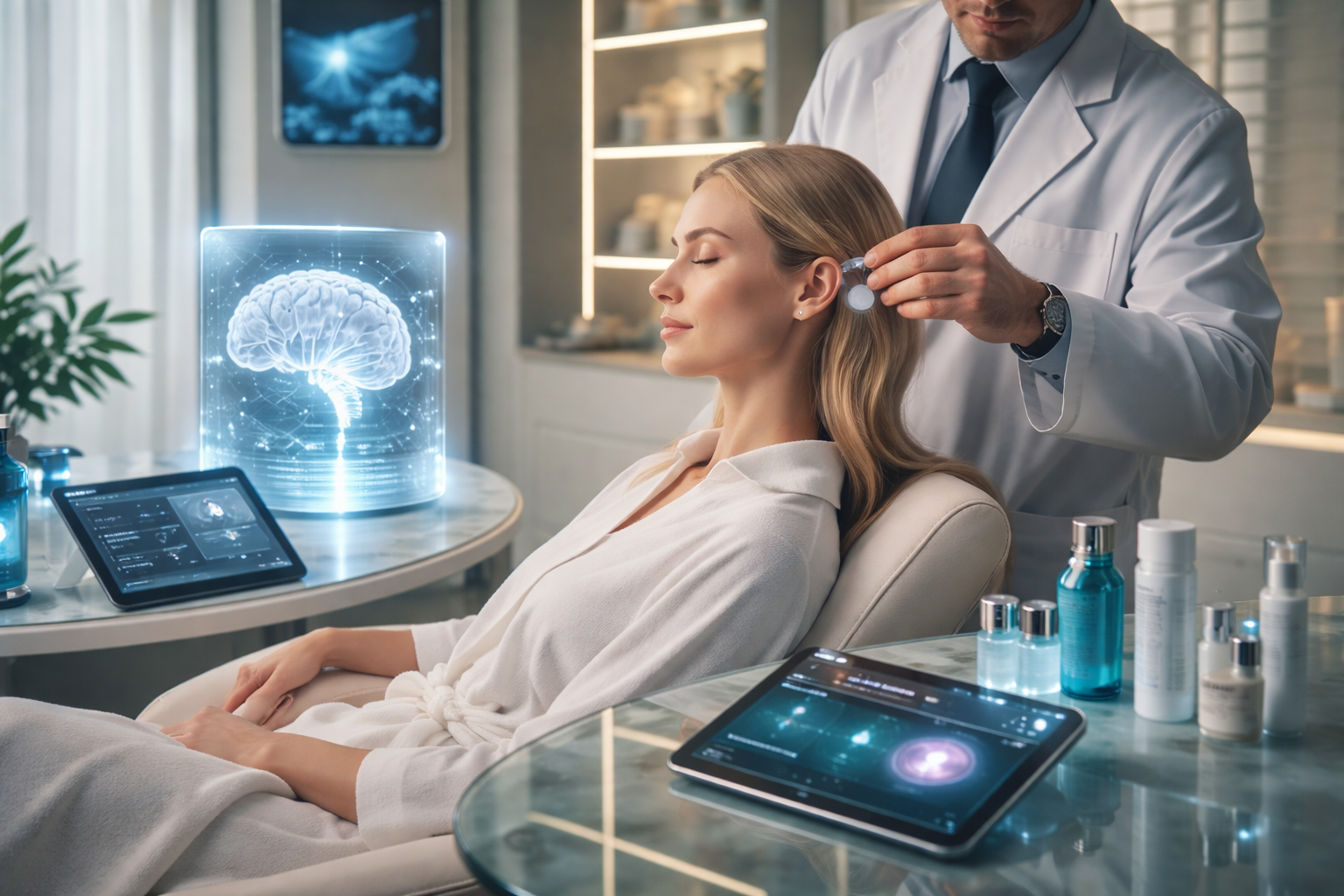
    Patient seated in a private clinic while a clinician adjusts a neural implant near the ear, with brain imaging displays and medical devices visible, indicating mood and appearance regulation technology.

    The neuro-aesthetic frontier and the quiet redefinition of intervention

    0
    By Elena Vance on 07.02.2026 Medical Breakthroughs, Health & Biohacking
    Share
    Facebook Twitter LinkedIn Copy Link

    A new category of intervention is emerging at the edges of medicine, design, and consumer technology. Neural implants intended to regulate mood, attention, and emotional tone are beginning to intersect with devices marketed for aesthetic modulation. The convergence is subtle. It does not announce itself through public health systems or large-scale adoption. It appears instead in specialised clinics, regulatory grey zones, and the language used to describe what is being offered.

    These implants are not framed primarily as treatments for disease. They are presented as instruments of calibration. Mood is adjusted. Stress is dampened. Focus is stabilised. In some cases, changes in posture, facial expression, or perceived vitality are described as secondary effects. The emphasis is on regulation rather than cure. This framing marks a shift in how intervention is justified and who is considered an appropriate subject for it.

    Institutional boundaries are being tested. Traditional medical oversight relies on clear distinctions between therapy and enhancement. Neuro-aesthetic implants blur that line. They operate on neural pathways associated with recognised conditions, yet are often deployed in individuals who do not meet diagnostic thresholds. Oversight mechanisms designed for treatment struggle to accommodate interventions aimed at optimisation or maintenance.

    Clinical practice reflects this tension. Many of these procedures are offered in private settings that combine medical licensing with wellness branding. Consent processes are formal, but the criteria for eligibility are broader than those used in public systems. Decisions about implantation are shaped less by pathology and more by client preference, tolerance for risk, and ability to pay. Responsibility shifts from institutional assessment to individual choice, mediated by professional discretion.

    The market response has been cautious but persistent. Manufacturers emphasise modularity and reversibility. Devices are described as adjustable rather than permanent. This language lowers the psychological barrier to adoption while avoiding claims that would trigger stricter regulation. Pricing structures reflect the positioning. Costs are high enough to limit access, reinforcing the perception of bespoke intervention rather than mass treatment.

    Governance adapts unevenly. Regulators focus on safety standards and post-market surveillance, but struggle to categorise devices whose primary function is experiential. Approval pathways exist, yet they are often navigated through indications adjacent to the intended use. The result is compliance without full alignment. Devices meet technical requirements while operating in conceptual spaces that regulation has not fully defined.

    Operational practice reveals how this plays out. Follow-up protocols prioritise user feedback and adjustment cycles over long-term outcome measurement. Data collection focuses on immediate effects and device performance rather than broader psychological impact. This reflects the way value is defined. Success is measured by satisfaction and stability, not by population-level benefit.

    The redistribution of risk is evident. When implants are framed as personal enhancements, adverse effects are treated as individual trade-offs rather than systemic failures. Liability is managed contractually. The institutional obligation to demonstrate benefit is reduced. Responsibility for long-term consequences becomes diffuse, shared between user, provider, and manufacturer without a clear centre.

    Aesthetic considerations add another layer. Changes in mood and affect influence how individuals present themselves. Confidence, expressiveness, and perceived vitality are shaped indirectly. This creates a feedback loop between internal regulation and external appearance. The implant is not altering appearance directly, but it modulates the conditions under which appearance is read and valued. This complicates the ethical framework traditionally applied to cosmetic intervention.

    Market behaviour reinforces the shift. Demand clusters among populations accustomed to managing their bodies as projects. The language of self-optimisation is familiar. Neuro-aesthetic implants are incorporated into broader regimes that include nutrition, cognitive training, and aesthetic procedures. The implant becomes one component in a managed system rather than an exceptional intervention.

    Institutional legitimacy adjusts in response. Professional authority is exercised through technical competence rather than moral boundary-setting. Clinicians position themselves as facilitators of informed choice. The question of whether an intervention should exist is displaced by the question of whether it can be delivered safely. This reorientation narrows the scope of institutional judgement.

    There are observable consequences for research priorities. Investment flows toward incremental improvements in control, comfort, and user interface. Long-term studies on identity, emotional variance, or social interaction receive less emphasis. The market rewards refinements that enhance adoption rather than inquiries that might complicate the narrative of regulation and control.

    Public discourse lags behind practice. Neuro-aesthetic implants are rarely discussed in mainstream debates about healthcare or technology. Their adoption is too limited to attract scrutiny, yet too advanced to be dismissed as speculative. This absence of attention allows norms to form quietly, shaped by early adopters and commercial incentives rather than collective deliberation.

    The concept of normality shifts in small increments. When mood regulation becomes a matter of adjustment rather than resilience, the baseline against which experience is measured changes. This does not require explicit endorsement. It is embedded in availability and usage. What is offered becomes what is expected, even if only within certain circles.

    Institutions respond through accommodation rather than resistance. Insurance systems largely exclude these interventions, reinforcing their status as elective. Public health frameworks observe from a distance. Professional bodies issue guidance that emphasises caution without drawing firm boundaries. The result is a landscape where practice advances ahead of consensus.

    The neuro-aesthetic frontier is not defined by a single technology or policy decision. It is shaped by the interaction of clinical discretion, market positioning, and regulatory adaptation. Control over mood and appearance is redistributed from collective norms to individual management, mediated by devices that promise adjustment rather than transformation.

    This redistribution matters because it alters how responsibility is assigned. Emotional states become variables to be managed. Appearance becomes an outcome of internal calibration. Institutions that once defined the limits of intervention now operate within them, adjusting procedures rather than principles.

    The tensions remain unresolved. Safety frameworks exist, but legitimacy is negotiated case by case. Risk is acknowledged, but normalised. Control is offered, but its implications are left largely unexamined. The neuro-aesthetic frontier advances not through confrontation, but through quiet incorporation into existing systems, reshaping expectations without demanding agreement.

    Keep Reading

    Peak State Protocols and the Data Behind Pharmaceutical Grade Nootropics

    WHO Publishes Updated Global Report on Ageing and Health

    The Neural Deceleration Movement and the High Stakes of Cognitive Recovery

    Digital Twins and the End of Clinical Trial Uncertainty

    Digital Minimalism and the Architecture of Cognitive Calm

    The Bio-Harmonic Home: Integrating Longevity Science into Living Spaces

    Leave A Reply Cancel Reply

    Latest Posts
    Advertisement
    Demo

    Recent Posts

    • The Sovereignty of the Self in an Age of Algorithmic Governance
    • The Chronos Strategy and the Death of the Always-On Executive Culture
    • Direct Indexing and the Democratization of Tax-Loss Harvesting for High-Net-Worth Portfolios
    • The Fragmentation Gamble and the Rise of Issue-Based Partnerships in the Global South
    • The Polycentric Shift and Why American Transactionalism is Redefining Global Power Dynamics in 2026
    Facebook X (Twitter) WhatsApp TikTok Instagram

    News

    • World News
    • Politics
    • Business
    • Technology

    Company

    • Privacy & Policy
    • Editorial Policy
    • Copyright & DMCA Policy
    • Terms of Use

    Contact

    • Contact
    • About Briefory

    Stay Informed. Stay Briefed.

    Essential global news, carefully selected and delivered by Briefory

    © 2026 Briefory.com Designed & Developed by lv8 – Consulting.
    • Privacy Policy
    • Terms
    • Copyright & DMCA Policy

    Type above and press Enter to search. Press Esc to cancel.

    Your privacy settings

    We and our partners use information collected through cookies and similar technologies to improve your experience on our site, analyse how you use it and for marketing purposes. Because we respect your right to privacy, you can choose not to allow some types of cookies. However, blocking some types of cookies may impact your experience of the site and the services we are able to offer. In some cases, data obtained from cookies is shared with third parties for analytics or marketing reasons. You can exercise your right to opt-out of that sharing at any time by disabling cookies.
    Privacy Policy

    Manage Consent Preferences

    Necessary

    Always ON
    These cookies and scripts are necessary for the website to function and cannot be switched off. They are usually only set in response to actions made by you which amount to a request for services, suchas setting your privacy preferences, logging in or filling in forms. You can set your browser to block oralert you about these cookies, but some parts of the site will not then work. These cookies do not store any personally identifiable information.

    Analytics

    These cookies and scripts allow us to count visits and traffic sources, so we can measure and improve the performance of our site. They help us know which pages are the most and least popular and see how visitors move around the site. All information these cookies collect is aggregated and therefore anonymous. If you do not allow these cookies and scripts, we will not know when you have visited our site.

    Embedded Videos

    These cookies and scripts may be set through our site by external video hosting services likeYouTube or Vimeo. They may be used to deliver video content on our website. It’s possible for the video provider to build a profile of your interests and show you relevant adverts on this or other websites. They do not store directly personal information, but are based on uniquely identifying your browser and internet device. If you do not allow these cookies or scripts it is possible that embedded video will not function as expected.

    Google Fonts

    Google Fonts is a font embedding service library. Google Fonts are stored on Google's CDN. The Google Fonts API is designed to limit the collection, storage, and use of end-user data to only what is needed to serve fonts efficiently. Use of Google Fonts API is unauthenticated. No cookies are sent by website visitors to the Google Fonts API. Requests to the Google Fonts API are made to resource-specific domains, such as fonts.googleapis.com or fonts.gstatic.com. This means your font requests are separate from and don't contain any credentials you send to google.com while using other Google services that are authenticated, such as Gmail.

    Marketing

    These cookies and scripts may be set through our site by our advertising partners. They may be used by those companies to build a profile of your interests and show you relevant adverts on other sites. They do not store directly personal information, but are based on uniquely identifying your browser and internet device. If you do not allow these cookies and scripts, you will experience less targeted advertising.
    Disable all Confirm my choices Allow all
    Verified by ConsentMagic
    My Consent Preferences