

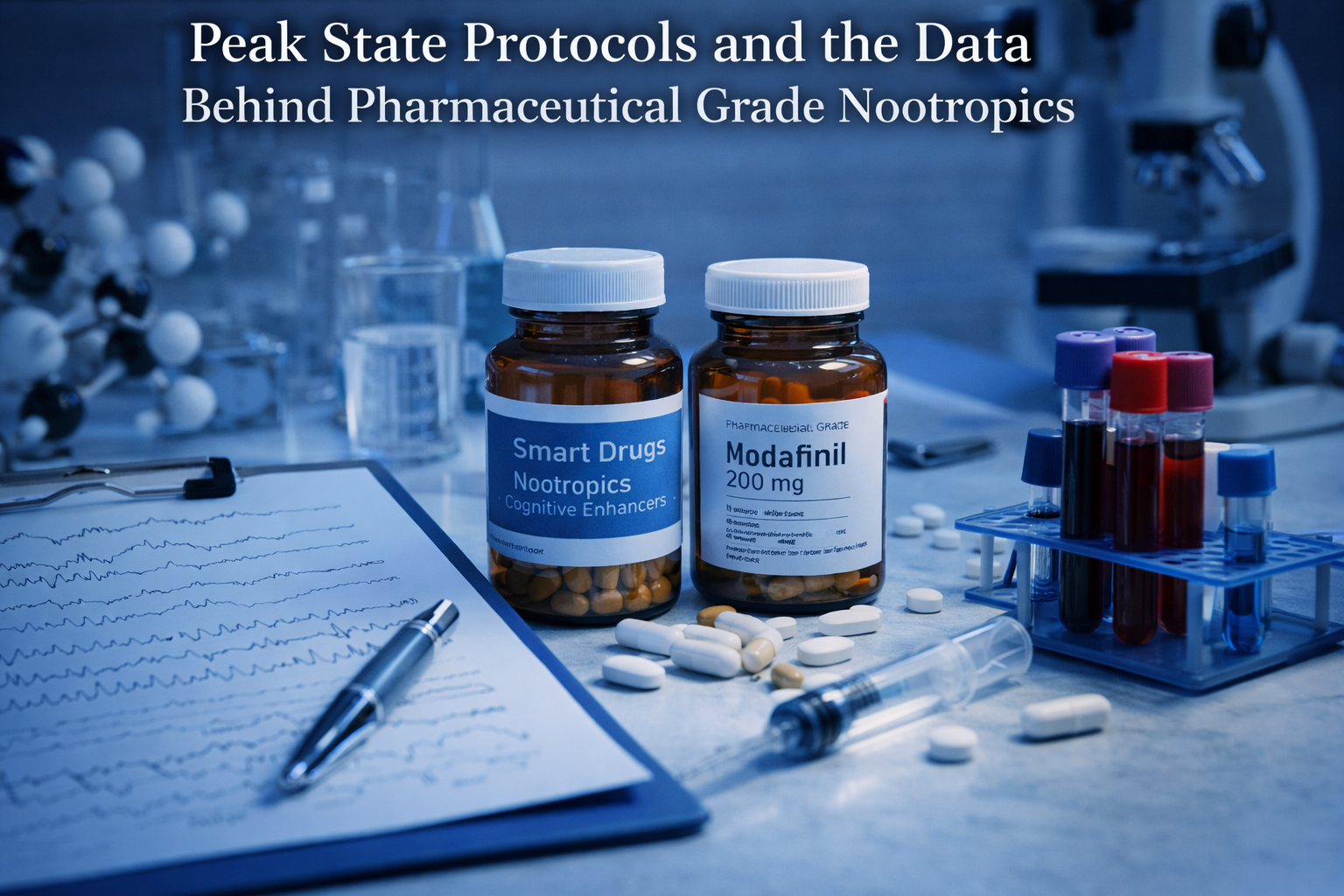
The pursuit of cognitive enhancement has moved from fringe experimentation to structured practice. What was once confined to niche online forums now appears in boardrooms, clinics, and performance coaching programs. The language has shifted as well. Terms such as peak state and protocol suggest discipline rather than improvisation. Behind that shift lies a growing body of data and a pharmaceutical supply chain that looks more institutional than countercultural.
Peak state protocols usually combine sleep management, nutrition, exercise, and cognitive training. Increasingly they also incorporate pharmaceutical grade nootropics. These are compounds developed for clinical use, often targeting attention disorders, sleep disorders, or neurodegenerative conditions. Their entry into performance culture reflects a broader pattern. Tools designed to restore function are being repurposed to extend it.
The economic context matters. Knowledge work has become the dominant form of labor in advanced economies. Productivity depends less on physical endurance and more on sustained attention, memory retention, and emotional regulation. In that environment, marginal gains in cognition can translate into measurable financial outcomes. The incentive to experiment is strong, particularly among high income professionals whose earnings are closely tied to output and speed.
Yet the data behind pharmaceutical grade nootropics is more nuanced than the marketing language suggests. Many of these compounds were tested in clinical populations under controlled conditions. Stimulant medications, for example, show clear benefits for individuals diagnosed with attention deficit disorders. In healthy adults, the evidence is mixed. Improvements in focus or wakefulness may come at the cost of sleep disruption, elevated heart rate, or dependence risk.
Modafinil, originally developed for narcolepsy, is often cited as a cognitive enhancer with a relatively benign side effect profile. Some studies show modest gains in executive function and reduced fatigue in sleep deprived subjects. But long term data in healthy populations remains limited. The absence of immediate harm is not the same as evidence of safety over decades. That distinction tends to fade in competitive environments.
There is also the question of dosage and supervision. Pharmaceutical grade implies manufacturing standards and regulatory oversight. It does not imply suitability for off label use without medical guidance. Informal peer networks frequently substitute for clinical oversight. Individuals exchange dosage strategies as if they were adjusting caffeine intake. The difference, of course, is pharmacological potency.
The structure of demand is revealing. High pressure industries have always experimented with stimulants. The difference now is formalization. Peak state protocols package cognitive enhancement into repeatable routines. Biometrics, wearable devices, and regular blood panels create a feedback loop. Performance is tracked. Adjustments are made. The process resembles portfolio management more than casual supplementation.
In some cases, families treat these regimens as investments in human capital. Parents inquire about cognitive enhancers for adolescents preparing for competitive examinations. Professionals discuss them in the same breath as advanced degrees. I have observed conversations where pharmaceutical enhancement was weighed against tutoring costs, almost clinically. The framing is pragmatic rather than rebellious.
But cognitive performance is not a single variable. Attention, creativity, resilience, and social judgment do not always move together. A compound that increases narrow focus may reduce cognitive flexibility. A protocol that maximizes wakefulness may impair recovery. The trade offs are subtle and often individual. Short term gains can mask longer term strain.
Regulatory systems were not designed with elective enhancement in mind. They evaluate drugs based on safety and efficacy for defined medical conditions. They do not assess fairness in competitive environments or the social pressure that widespread adoption can create. If a critical mass of professionals use pharmaceutical aids, abstention may feel like disadvantage rather than choice.
This creates a feedback dynamic. As more data accumulates, both positive and negative, the perception of normal performance shifts. Baseline expectations rise. What was once considered exceptional focus becomes standard. The boundary between therapy and enhancement blurs further.
There is also a psychological dimension that metrics struggle to capture. The belief that performance depends on a compound can alter self perception. Some users report increased confidence simply from following a structured protocol. Others describe anxiety when a dose is missed. Dependence can be behavioral as well as chemical.
None of this suggests that pharmaceutical grade nootropics lack value. In clinical settings they improve quality of life for many patients. Even in healthy adults, carefully supervised use may offer situational benefits. The question is less about immediate efficacy and more about long term system effects. What happens when cognitive enhancement becomes embedded in professional norms.
Peak state protocols reflect a broader shift toward data driven self management. They treat the mind as an asset to be optimized and protected. That framing carries both discipline and risk. The data behind these compounds continues to evolve. So does the social context in which they are used.
For now, the evidence supports caution alongside curiosity. Cognitive enhancement through pharmaceuticals is neither a miracle nor a moral failing. It is a structural response to economic incentives and performance pressure. How institutions respond will shape whether these tools remain optional aids or become quiet expectations.