

Close Menu
Briefory
    What's Hot

    The Sovereignty of the Self in an Age of Algorithmic Governance

    13.02.2026

    The Chronos Strategy and the Death of the Always-On Executive Culture

    13.02.2026

    Direct Indexing and the Democratization of Tax-Loss Harvesting for High-Net-Worth Portfolios

    13.02.2026
    Facebook X (Twitter) Instagram
    Trending
    • The Sovereignty of the Self in an Age of Algorithmic Governance
    • The Chronos Strategy and the Death of the Always-On Executive Culture
    • Direct Indexing and the Democratization of Tax-Loss Harvesting for High-Net-Worth Portfolios
    • The Fragmentation Gamble and the Rise of Issue-Based Partnerships in the Global South
    • The Polycentric Shift and Why American Transactionalism is Redefining Global Power Dynamics in 2026
    • The Neuro-Symbolic Pivot and Why Pure Neural Networks are Reaching a Reasoning Ceiling
    • Trans-Arctic Cable Initiative Gains Momentum Amid Strategic Rivalry
    • Beyond Silicon and the Commercial Viability of Diamond-Based Power Electronics
    Facebook X (Twitter) Instagram
    BrieforyBriefory
    Sunday, April 19
    • World
      • Americas
      • Europe
      • Asia-Pacific
      • Africa
      • Middle East
    • Economy & Business
      • Global Economy
      • Real Estate
      • Startups
    • Finance & Markets
      • Stock Market
      • Crypto & Web3
      • Commodities
      • Forex
    • Health & Biohacking
      • Longevity
      • Mental Wellness
      • Medical Breakthroughs
    • Lifestyle & Luxury
      • High-End Travel
      • Sustainable Living
      • Work-Life Balance
    • Personal Finance
      • Global Tax & Equity
      • Retirement Planning
      • Wealth Management
    • Perspectives
      • Expert Briefings
      • Future Trends
      • Global Opinions
    • Tech & AI
      • Artificial Intelligence
      • Cyber Security
      • Future Tech
    • The Brief
      • Daily Briefings
      • Tech Radar
      • Deep Dives
    Briefory
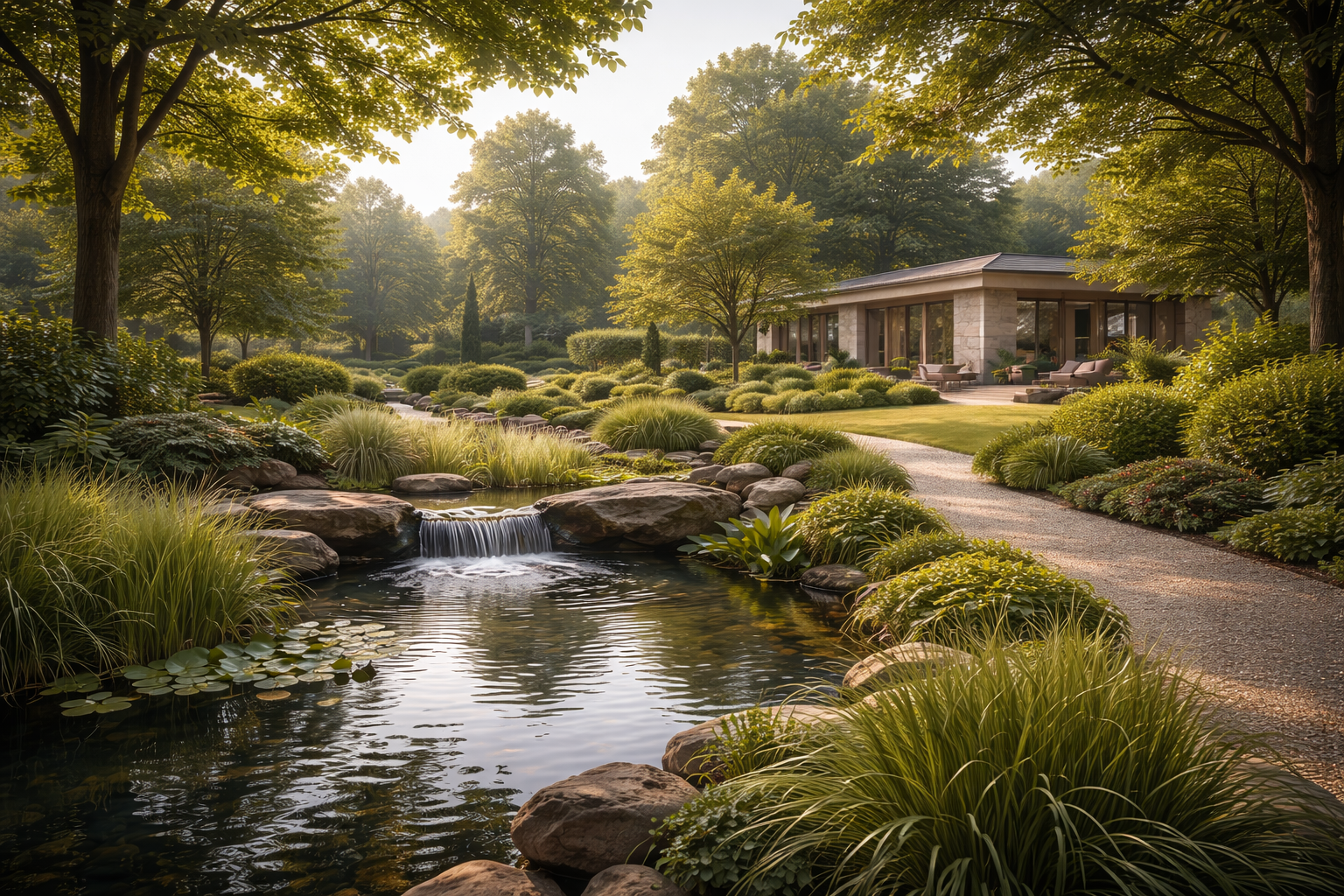
    Landscape designed for sound control with trees, water features, and soft terrain surrounding a luxury residence, illustrating acoustic ecology in high end estate design.

    The Silent Estate: Acoustic Ecology and the Luxury of Sound-Dampening Landscapes

    0
    By Elena Vance on 10.02.2026 Sustainable Living, Lifestyle & Luxury
    Share
    Facebook Twitter LinkedIn Copy Link

    For much of modern real estate history, silence was treated as an absence. A lack of traffic, a distance from industry, a quiet night. It was a condition achieved by removal rather than design. In high end residential development, that assumption is shifting. Sound is no longer something to be kept out. It is something to be shaped.

    Acoustic ecology, once a marginal concern of environmental science and urban planning, has entered the language of luxury development. Estates, resorts, and private residences are increasingly designed around controlled soundscapes. The goal is not total quiet. It is predictability, softness, and containment. Noise is managed as a material variable rather than an external nuisance.

    This change reflects how exposure is now understood. Long term sound affects sleep, stress regulation, and cognitive recovery. These effects are cumulative rather than immediate. They do not announce themselves as acute harm. Instead, they settle into daily patterns. For residents with the means to control environment, reducing this form of exposure has become a priority.

    Developers have responded by moving acoustic strategy outdoors. Landscapes are no longer neutral buffers between structures. They are engineered layers. Terrain is shaped to redirect sound. Dense vegetation is selected not only for appearance but for absorption properties. Water features are positioned to mask irregular noise with steady frequencies. Hard surfaces are minimized in favor of materials that scatter rather than reflect.

    This approach contrasts with earlier solutions that relied heavily on insulation and enclosure. Thick walls and sealed windows addressed interior quiet but often created sealed environments detached from surroundings. The new emphasis is on continuity. Sound is moderated before it reaches the building. The exterior becomes part of the acoustic system.

    In luxury contexts, this is framed less as mitigation and more as enhancement. Quiet is presented as a feature of the estate rather than a byproduct of location. Marketing language often avoids the word silence altogether. Instead, it references calm, depth, or atmosphere. The underlying shift, however, is technical. Acoustic modeling is now integrated into site planning alongside drainage, light, and access.

    This integration changes how land is valued. Proximity to infrastructure no longer disqualifies a site automatically if sound can be managed at scale. Conversely, remote locations lose some of their premium if soundscapes cannot be shaped reliably. The value moves from distance to control. What matters is not how far noise sources are, but how effectively they are filtered.

    Responsibility shifts with this framing. In traditional development, noise complaints were external disputes between residents and surrounding activity. With acoustic ecology embedded in design, the developer assumes a more active role. Expectations are set at purchase. Quiet becomes an implied service. When it fails, dissatisfaction is directed inward rather than outward.

    This has governance implications. Local authorities still regulate decibel limits and zoning, but these thresholds address harm, not comfort. Luxury acoustic landscapes operate above regulatory minimums. They establish private standards that exceed public ones. Over time, these standards influence planning negotiations and environmental assessments, even if they are not codified.

    There is also a question of permanence. Sound dampening landscapes require maintenance. Vegetation grows, thins, or dies. Water features demand energy and upkeep. Earthworks settle. Unlike walls, these systems evolve. Their effectiveness changes with seasons and years. Quiet must be sustained, not installed once.

    An uncomfortable feature of this model is its exclusivity. The capacity to engineer calm at a landscape scale is expensive and land intensive. It appears in estates, gated communities, and private developments with controlled boundaries. Meanwhile, urban environments with dense populations continue to absorb unmanaged noise. Acoustic relief becomes unevenly distributed.

    The notion of acoustic ecology also reframes luxury itself. Traditionally associated with visibility and display, luxury here is defined by absence and restraint. The most valuable feature is something that cannot be photographed easily. Silence, or something close to it, resists representation. This shifts how prestige is communicated. Ownership signals less through spectacle and more through experience.

    Institutionally, this aligns with broader changes in how well being is incorporated into asset design. Sound joins air, light, and thermal stability as an environmental input that can be optimized. The estate becomes an operating system rather than a static object. Each element contributes to a baseline condition rather than a moment of impact.

    The silent estate does not eliminate noise. It reorganizes it. Certain sounds are permitted, even emphasized. Wind through trees, water movement, distant wildlife. Others are absorbed or redirected. This selective filtering produces a curated environment that feels natural while being carefully managed.

    What remains unresolved is how these private soundscapes relate to their surroundings. Acoustic control within boundaries can displace noise outward. The quiet of one place may intensify sound elsewhere. These effects are rarely visible and difficult to attribute. They sit at the edge of current planning frameworks.

    The rise of sound dampening landscapes reflects a deeper change in how environment is perceived. Noise is no longer an external condition to tolerate. It is an internal variable to manage. For those with access, silence becomes less about escape and more about design. The landscape itself takes on responsibility for mental and physical ease, long before any building is entered.

    Keep Reading

    The Chronos Strategy and the Death of the Always-On Executive Culture

    The Silent Voyage and Why Ultra-Private Orbital Tourism is the Final Frontier of Luxury

    Beyond Plastic-Free: The Rise of Regenerative Estates and Self-Sustaining Luxury Ecosystems

    The “Soft Life” Economy: Why High-Net-Worth Individuals are Prioritizing Time-Arbitrage over Status Symbols

    The Dawn of Orbital Hospitality and the Privatization of the Horizon

    The Rise of Closed Loop Estates and the New Ethics of Radical Autarky

    Leave A Reply Cancel Reply

    Latest Posts
    Advertisement
    Demo

    Recent Posts

    • The Sovereignty of the Self in an Age of Algorithmic Governance
    • The Chronos Strategy and the Death of the Always-On Executive Culture
    • Direct Indexing and the Democratization of Tax-Loss Harvesting for High-Net-Worth Portfolios
    • The Fragmentation Gamble and the Rise of Issue-Based Partnerships in the Global South
    • The Polycentric Shift and Why American Transactionalism is Redefining Global Power Dynamics in 2026
    Facebook X (Twitter) WhatsApp TikTok Instagram

    News

    • World News
    • Politics
    • Business
    • Technology

    Company

    • Privacy & Policy
    • Editorial Policy
    • Copyright & DMCA Policy
    • Terms of Use

    Contact

    • Contact
    • About Briefory

    Stay Informed. Stay Briefed.

    Essential global news, carefully selected and delivered by Briefory

    © 2026 Briefory.com Designed & Developed by lv8 – Consulting.
    • Privacy Policy
    • Terms
    • Copyright & DMCA Policy

    Type above and press Enter to search. Press Esc to cancel.

    Your privacy settings

    We and our partners use information collected through cookies and similar technologies to improve your experience on our site, analyse how you use it and for marketing purposes. Because we respect your right to privacy, you can choose not to allow some types of cookies. However, blocking some types of cookies may impact your experience of the site and the services we are able to offer. In some cases, data obtained from cookies is shared with third parties for analytics or marketing reasons. You can exercise your right to opt-out of that sharing at any time by disabling cookies.
    Privacy Policy

    Manage Consent Preferences

    Necessary

    Always ON
    These cookies and scripts are necessary for the website to function and cannot be switched off. They are usually only set in response to actions made by you which amount to a request for services, suchas setting your privacy preferences, logging in or filling in forms. You can set your browser to block oralert you about these cookies, but some parts of the site will not then work. These cookies do not store any personally identifiable information.

    Analytics

    These cookies and scripts allow us to count visits and traffic sources, so we can measure and improve the performance of our site. They help us know which pages are the most and least popular and see how visitors move around the site. All information these cookies collect is aggregated and therefore anonymous. If you do not allow these cookies and scripts, we will not know when you have visited our site.

    Embedded Videos

    These cookies and scripts may be set through our site by external video hosting services likeYouTube or Vimeo. They may be used to deliver video content on our website. It’s possible for the video provider to build a profile of your interests and show you relevant adverts on this or other websites. They do not store directly personal information, but are based on uniquely identifying your browser and internet device. If you do not allow these cookies or scripts it is possible that embedded video will not function as expected.

    Google Fonts

    Google Fonts is a font embedding service library. Google Fonts are stored on Google's CDN. The Google Fonts API is designed to limit the collection, storage, and use of end-user data to only what is needed to serve fonts efficiently. Use of Google Fonts API is unauthenticated. No cookies are sent by website visitors to the Google Fonts API. Requests to the Google Fonts API are made to resource-specific domains, such as fonts.googleapis.com or fonts.gstatic.com. This means your font requests are separate from and don't contain any credentials you send to google.com while using other Google services that are authenticated, such as Gmail.

    Marketing

    These cookies and scripts may be set through our site by our advertising partners. They may be used by those companies to build a profile of your interests and show you relevant adverts on other sites. They do not store directly personal information, but are based on uniquely identifying your browser and internet device. If you do not allow these cookies and scripts, you will experience less targeted advertising.
    Disable all Confirm my choices Allow all
    Verified by ConsentMagic
    My Consent Preferences