

Close Menu
Briefory
    What's Hot

    The Sovereignty of the Self in an Age of Algorithmic Governance

    13.02.2026

    The Chronos Strategy and the Death of the Always-On Executive Culture

    13.02.2026

    Direct Indexing and the Democratization of Tax-Loss Harvesting for High-Net-Worth Portfolios

    13.02.2026
    Facebook X (Twitter) Instagram
    Trending
    • The Sovereignty of the Self in an Age of Algorithmic Governance
    • The Chronos Strategy and the Death of the Always-On Executive Culture
    • Direct Indexing and the Democratization of Tax-Loss Harvesting for High-Net-Worth Portfolios
    • The Fragmentation Gamble and the Rise of Issue-Based Partnerships in the Global South
    • The Polycentric Shift and Why American Transactionalism is Redefining Global Power Dynamics in 2026
    • The Neuro-Symbolic Pivot and Why Pure Neural Networks are Reaching a Reasoning Ceiling
    • Trans-Arctic Cable Initiative Gains Momentum Amid Strategic Rivalry
    • Beyond Silicon and the Commercial Viability of Diamond-Based Power Electronics
    Facebook X (Twitter) Instagram
    BrieforyBriefory
    Sunday, April 19
    • World
      • Americas
      • Europe
      • Asia-Pacific
      • Africa
      • Middle East
    • Economy & Business
      • Global Economy
      • Real Estate
      • Startups
    • Finance & Markets
      • Stock Market
      • Crypto & Web3
      • Commodities
      • Forex
    • Health & Biohacking
      • Longevity
      • Mental Wellness
      • Medical Breakthroughs
    • Lifestyle & Luxury
      • High-End Travel
      • Sustainable Living
      • Work-Life Balance
    • Personal Finance
      • Global Tax & Equity
      • Retirement Planning
      • Wealth Management
    • Perspectives
      • Expert Briefings
      • Future Trends
      • Global Opinions
    • Tech & AI
      • Artificial Intelligence
      • Cyber Security
      • Future Tech
    • The Brief
      • Daily Briefings
      • Tech Radar
      • Deep Dives
    Briefory
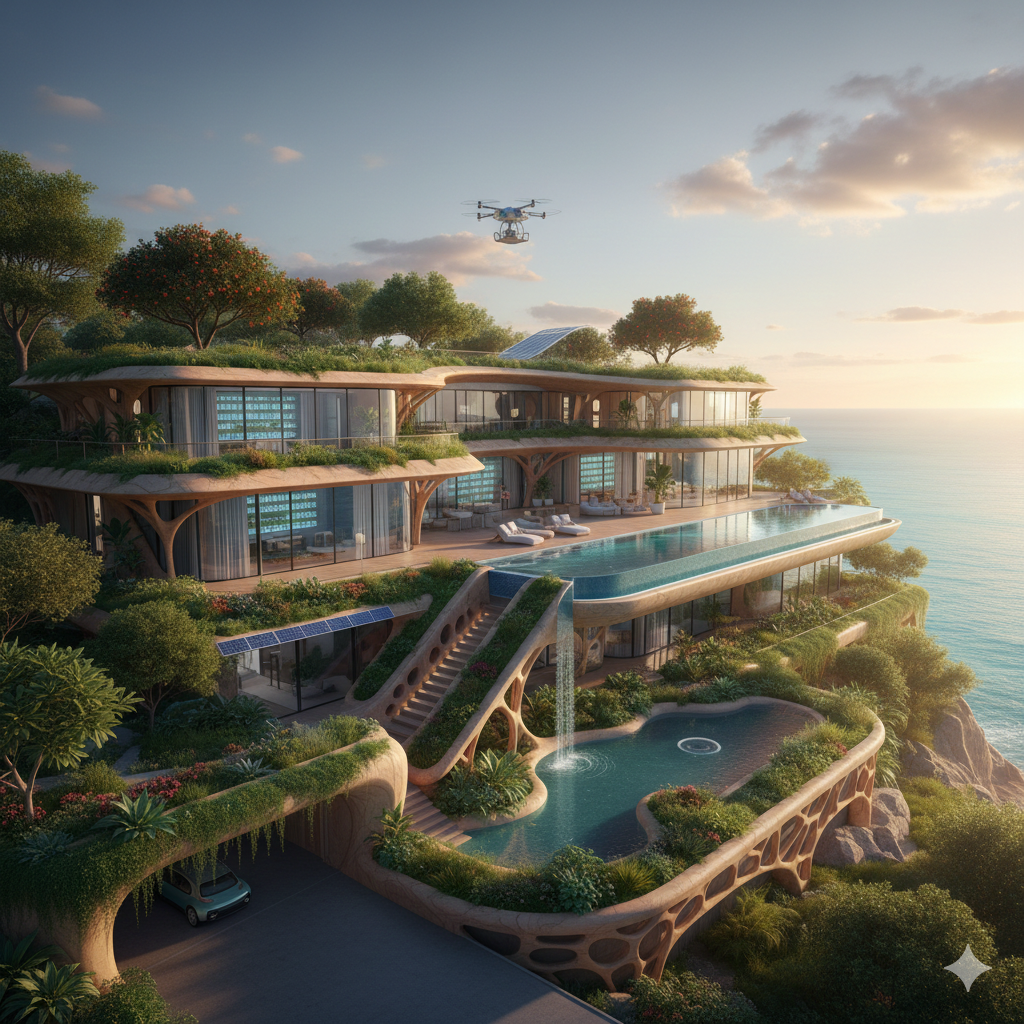
    Futuristic luxury eco-villa with integrated greenery and solar technology illustrating the pinnacle of sustainable living.

    Regenerative Architecture and the New Era of Conscious Luxury

    0
    By Elena Vance on 04.02.2026 Sustainable Living, Lifestyle & Luxury
    Share
    Facebook Twitter LinkedIn Copy Link

    For much of the past two decades, sustainable living was framed as an act of restraint. Homes were praised for using less energy, wasting fewer resources, and reducing their environmental footprint. While this approach marked important progress, it also carried an implicit compromise. Sustainability was something achieved by subtraction.

    By 2026, that narrative has shifted.

    At the highest end of the lifestyle market, sustainability is no longer defined by reduction. It is defined by contribution. Regenerative living represents a new architectural philosophy, one in which homes are designed to actively restore the environments they occupy. Rather than minimizing impact, these spaces are engineered to produce more energy, purify more water, and support more life than they consume.

    This is the new expression of conscious luxury.

    Regenerative architecture redefines what it means to live well. These homes are built as net positive systems. They generate surplus renewable energy, often feeding it back into local grids or shared micro networks. Water systems capture, filter, and replenish groundwater, while advanced landscaping stabilizes soil and supports biodiversity.

    In this context, luxury is not excess. It is alignment. The privilege lies in living within a system that enhances its surroundings rather than extracting from them.

    Design plays a central role in this shift. Regenerative homes are deeply biophilic, but not in a superficial way. Living walls and green roofs are functional infrastructure, filtering air, regulating temperature, and creating habitats for insects and birds. Interior spaces blur the boundary between indoors and outdoors, encouraging a constant relationship with natural cycles.

    Food production is increasingly integrated into residential design. Indoor gardens, rooftop greenhouses, and small scale permaculture systems provide year round access to fresh produce. Beyond convenience, this creates nutritional independence and reduces reliance on external supply chains. Autonomy becomes part of everyday life.

    The materials used in regenerative architecture reflect a similar philosophy. Buildings are increasingly constructed from biomaterials that capture carbon rather than emit it. Lab grown mycelium composites, engineered timber, and recycled marine plastics are replacing traditional high impact materials. These choices are driven as much by aesthetics and performance as by environmental considerations.

    Technology in these homes is sophisticated but intentionally discreet. Smart surfaces adjust light and temperature in response to circadian rhythms. Windows function as energy collectors. Structural systems monitor air quality, humidity, and resource flows continuously, optimizing performance without demanding attention.

    This invisibility is intentional. True luxury, in this model, is not defined by visible technology but by how seamlessly a home supports its inhabitants.

    Resilience has become another defining factor. Climate volatility, infrastructure strain, and energy uncertainty have reshaped perceptions of security. A regenerative home offers independence from fragile systems. Power, water, and food security are built into the architecture itself.

    For many homeowners, this resilience delivers a sense of calm that traditional luxury properties cannot replicate. The home becomes not just a place of comfort, but a stable anchor in an unpredictable world.

    Beyond individual benefit, regenerative architecture signals a broader cultural shift. It reflects an emerging understanding that wealth is inseparable from ecological health. A beautiful home loses its meaning if the environment around it degrades.

    By designing spaces that restore ecosystems, homeowners participate in a larger act of stewardship. Architecture becomes a bridge between human comfort and planetary well being.

    In this sense, regenerative living represents a new social contract. It acknowledges that modern luxury must operate within ecological limits while still offering beauty, privacy, and autonomy.

    As we move deeper into 2026, prestige is being redefined. The most desirable homes are no longer those that dominate their surroundings, but those that quietly sustain them. Conscious luxury is no longer about what a home displays, but about what it gives back.

    The most valuable address of the future may be the one that leaves the smallest footprint and the most enduring legacy of life.

    Keep Reading

    The Chronos Strategy and the Death of the Always-On Executive Culture

    The Silent Voyage and Why Ultra-Private Orbital Tourism is the Final Frontier of Luxury

    Beyond Plastic-Free: The Rise of Regenerative Estates and Self-Sustaining Luxury Ecosystems

    The “Soft Life” Economy: Why High-Net-Worth Individuals are Prioritizing Time-Arbitrage over Status Symbols

    The Dawn of Orbital Hospitality and the Privatization of the Horizon

    The Rise of Closed Loop Estates and the New Ethics of Radical Autarky

    Leave A Reply Cancel Reply

    Latest Posts
    Advertisement
    Demo

    Recent Posts

    • The Sovereignty of the Self in an Age of Algorithmic Governance
    • The Chronos Strategy and the Death of the Always-On Executive Culture
    • Direct Indexing and the Democratization of Tax-Loss Harvesting for High-Net-Worth Portfolios
    • The Fragmentation Gamble and the Rise of Issue-Based Partnerships in the Global South
    • The Polycentric Shift and Why American Transactionalism is Redefining Global Power Dynamics in 2026
    Facebook X (Twitter) WhatsApp TikTok Instagram

    News

    • World News
    • Politics
    • Business
    • Technology

    Company

    • Privacy & Policy
    • Editorial Policy
    • Copyright & DMCA Policy
    • Terms of Use

    Contact

    • Contact
    • About Briefory

    Stay Informed. Stay Briefed.

    Essential global news, carefully selected and delivered by Briefory

    © 2026 Briefory.com Designed & Developed by lv8 – Consulting.
    • Privacy Policy
    • Terms
    • Copyright & DMCA Policy

    Type above and press Enter to search. Press Esc to cancel.

    Your privacy settings

    We and our partners use information collected through cookies and similar technologies to improve your experience on our site, analyse how you use it and for marketing purposes. Because we respect your right to privacy, you can choose not to allow some types of cookies. However, blocking some types of cookies may impact your experience of the site and the services we are able to offer. In some cases, data obtained from cookies is shared with third parties for analytics or marketing reasons. You can exercise your right to opt-out of that sharing at any time by disabling cookies.
    Privacy Policy

    Manage Consent Preferences

    Necessary

    Always ON
    These cookies and scripts are necessary for the website to function and cannot be switched off. They are usually only set in response to actions made by you which amount to a request for services, suchas setting your privacy preferences, logging in or filling in forms. You can set your browser to block oralert you about these cookies, but some parts of the site will not then work. These cookies do not store any personally identifiable information.

    Analytics

    These cookies and scripts allow us to count visits and traffic sources, so we can measure and improve the performance of our site. They help us know which pages are the most and least popular and see how visitors move around the site. All information these cookies collect is aggregated and therefore anonymous. If you do not allow these cookies and scripts, we will not know when you have visited our site.

    Embedded Videos

    These cookies and scripts may be set through our site by external video hosting services likeYouTube or Vimeo. They may be used to deliver video content on our website. It’s possible for the video provider to build a profile of your interests and show you relevant adverts on this or other websites. They do not store directly personal information, but are based on uniquely identifying your browser and internet device. If you do not allow these cookies or scripts it is possible that embedded video will not function as expected.

    Google Fonts

    Google Fonts is a font embedding service library. Google Fonts are stored on Google's CDN. The Google Fonts API is designed to limit the collection, storage, and use of end-user data to only what is needed to serve fonts efficiently. Use of Google Fonts API is unauthenticated. No cookies are sent by website visitors to the Google Fonts API. Requests to the Google Fonts API are made to resource-specific domains, such as fonts.googleapis.com or fonts.gstatic.com. This means your font requests are separate from and don't contain any credentials you send to google.com while using other Google services that are authenticated, such as Gmail.

    Marketing

    These cookies and scripts may be set through our site by our advertising partners. They may be used by those companies to build a profile of your interests and show you relevant adverts on other sites. They do not store directly personal information, but are based on uniquely identifying your browser and internet device. If you do not allow these cookies and scripts, you will experience less targeted advertising.
    Disable all Confirm my choices Allow all
    Verified by ConsentMagic
    My Consent Preferences