

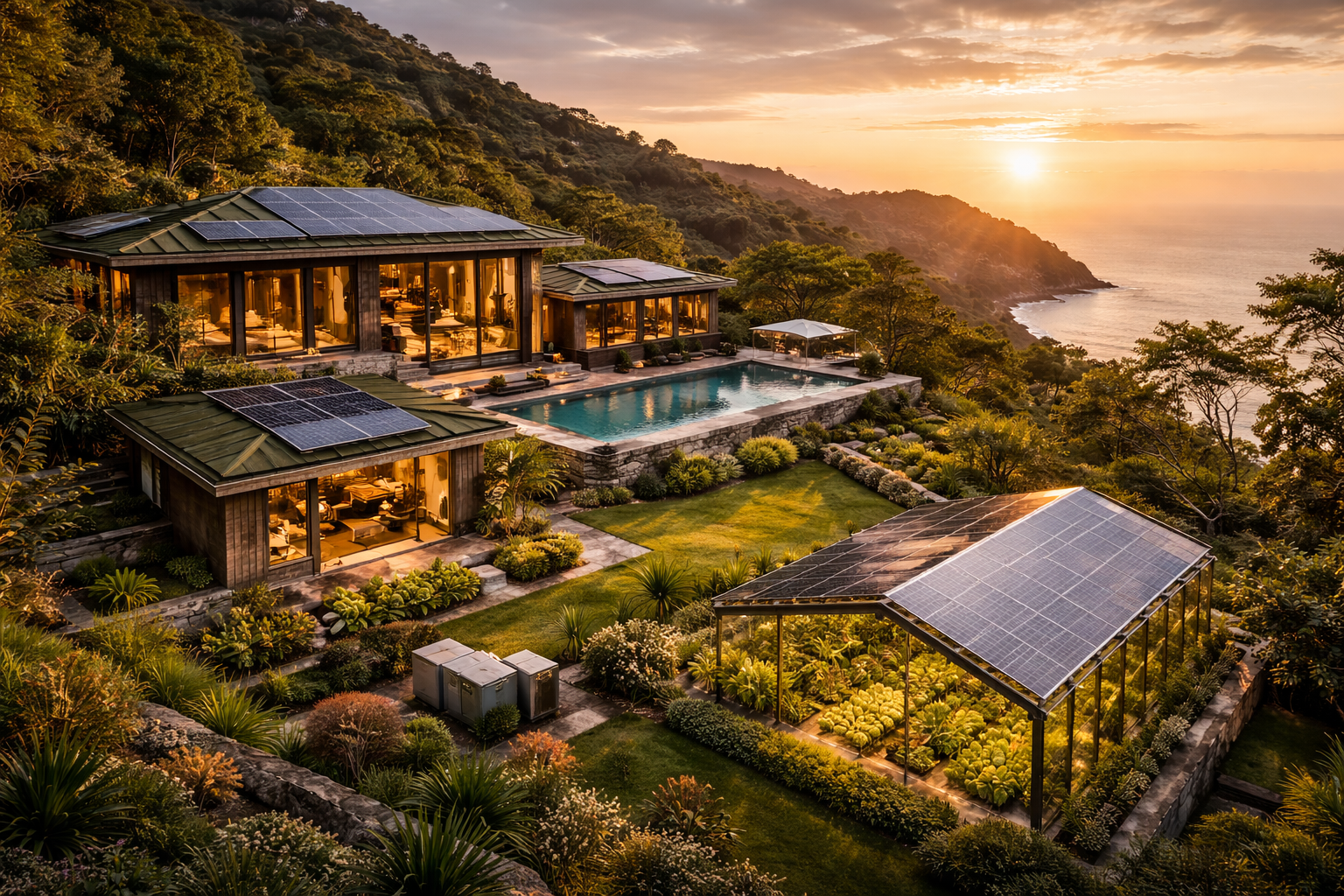
For much of the past two decades, sustainability in luxury living was framed as an ethical consideration rather than a core value. Environmentally conscious features were often presented as optional additions, secondary to comfort, scale, and visual impact. That distinction is now fading.
As 2026 unfolds, self sufficiency has moved to the center of high end residential design. Among affluent buyers and developers, sustainability is no longer associated with restraint. Instead, it is increasingly understood as a form of strategic advantage. Control over energy, water, and resources has become a defining characteristic of modern luxury.
This shift is most visible in the growing demand for autonomous estates. These properties are designed to operate independently of public infrastructure, producing their own energy, managing water systems on site, and minimizing reliance on external supply chains. While environmental concerns play a role, the underlying motivation is resilience.
Volatile energy markets, aging grids, and climate related disruptions have reshaped how long term value is assessed. In this context, a self sufficient residence offers stability. It reduces exposure to external shocks while maintaining the level of comfort expected at the highest end of the market.
Technology enables this transformation, but it does so discreetly. The emphasis is no longer on visible sustainability features, but on integration. Energy generation is embedded within building materials. Thermal regulation is achieved through architectural design rather than mechanical intervention. Systems operate quietly in the background, adjusting to conditions without requiring constant oversight.
Water management follows a similar logic. Rain capture, atmospheric extraction, and advanced filtration systems allow estates to function without municipal supply. Waste is treated as a resource rather than a liability, contributing to closed loop ecosystems that support both landscape and habitation.
This level of autonomy requires significant engineering sophistication. As a result, self sufficient luxury has become a marker of technical literacy as much as wealth. These properties signal an understanding of systems, not just aesthetics. They represent foresight rather than excess.
Food production is also being reimagined within this framework. Many autonomous estates now incorporate controlled environment agriculture, including vertical farms and hydroponic installations. These systems provide consistent access to fresh produce while reducing dependence on external logistics. The appeal lies not only in quality, but in continuity.
From a market perspective, the economics of self sufficiency are increasingly persuasive. While upfront investment remains substantial, operational costs over time are significantly lower. Energy independence reduces long term expense and risk, while sustainable design enhances durability and future proofing.
Real estate valuations are beginning to reflect this shift. Properties capable of meeting their own resource needs are demonstrating stronger resilience in pricing, particularly in regions exposed to climate stress or infrastructure constraints. Sustainability is no longer viewed as a differentiator. It is becoming a baseline expectation for preserving value.
This evolution reflects a broader reassessment of what luxury represents. Traditional markers of status, size, location, visibility, are being supplemented by quieter forms of distinction. Independence, reliability, and environmental alignment now carry equal weight.
The move toward luxury self sufficiency does not suggest withdrawal from society or technology. Rather, it indicates a recalibration of dependence. Owners are choosing to engage with systems on their own terms, reducing vulnerability while maintaining comfort.
In this sense, sustainable living is no longer framed as a moral obligation. It is positioned as the most advanced expression of control and security. Autonomy becomes the ultimate amenity.
As expectations continue to evolve, self sufficient estates are likely to set the standard rather than occupy a niche. In a world defined by uncertainty, the ability to live well without reliance on fragile systems has become the clearest signal of modern luxury.