

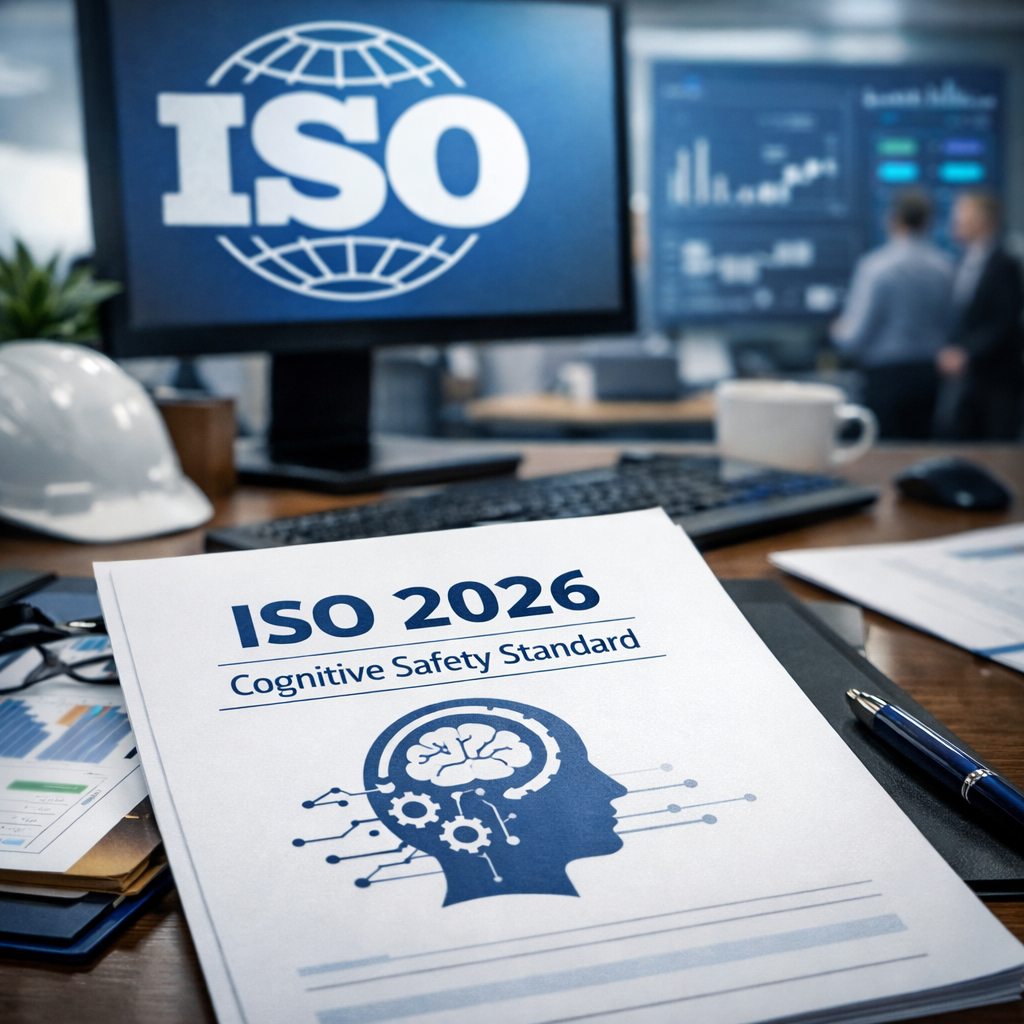
The International Organization for Standardization has formally adopted ISO 2026, the first international standard addressing cognitive safety in workplace environments. The standard sets out common definitions, baseline requirements, and risk management principles related to mental load, attentional strain, and cognitive stress during work activities. Its adoption marks the first time cognitive safety has been treated as a distinct category within the ISO system, alongside physical safety, information security, and occupational health.
ISO 2026 was approved following a multi-year process involving national standards bodies, occupational health experts, neuroscientists, and representatives from industry and labor organizations. The work was coordinated through a dedicated technical committee formed to address emerging risks associated with knowledge-intensive work, digital tools, and sustained attention demands. Delegations from more than 40 countries participated in the drafting and review process.
The standard defines cognitive safety as the condition in which work systems, tasks, and environments are designed to avoid excessive mental strain that could impair attention, decision-making, memory, or psychological stability in the short term. It outlines how organizations should identify cognitive risk factors linked to workload intensity, interruption frequency, task complexity, information density, and extended periods of focused or fragmented attention.
ISO 2026 does not set performance targets or clinical thresholds. Instead, it provides a framework for assessment and prevention. It requires organizations seeking alignment to document cognitive demands associated with roles and processes, implement controls to reduce identified risks, and monitor indicators related to mental fatigue and attentional overload. The standard emphasizes integration with existing occupational health and safety management systems rather than standalone certification.
The document also addresses the impact of digital work environments. It includes guidance on the use of monitoring software, notification systems, and always-on communication tools. It calls for limits on unnecessary interruptions and clearer task boundaries in roles that rely heavily on sustained concentration. Remote and hybrid work arrangements are explicitly included within its scope.
ISO officials said the standard responds to increased reporting of work-related cognitive strain across sectors such as technology, finance, healthcare, aviation, and advanced manufacturing. In these fields, errors linked to attention failure or mental fatigue can have immediate operational or safety consequences. National regulators and large employers had requested a harmonized reference point to guide internal policies and audits.
As with other ISO management standards, ISO 2026 is voluntary. It does not carry legal force unless referenced by national legislation or contractual requirements. Several national standards bodies have already indicated plans to adopt the text as a national standard or to align existing occupational health guidance with its terminology.
The standard will be reviewed on a regular cycle, consistent with ISO procedures, to reflect new scientific evidence and workplace practices. Implementation guidance documents are expected to be published separately to support organizations applying the framework across different sectors.
ISO 2026 is available through national standards organizations and the ISO catalogue. Its publication adds cognitive safety to the growing list of formally recognized dimensions of workplace risk addressed through international standardization.